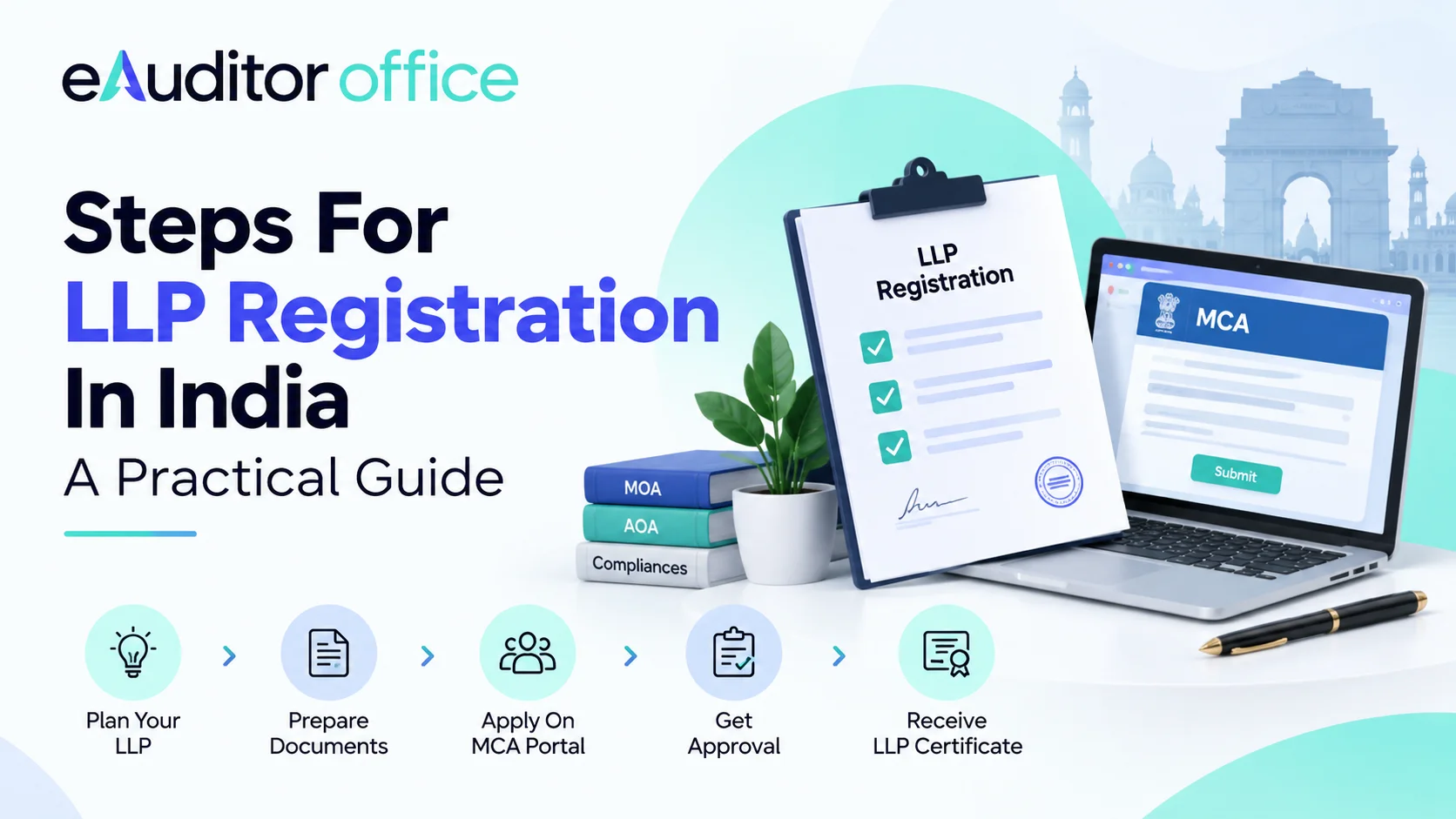
The main steps for LLP registration are checking partner eligibility, arranging digital signatures, selecting a name, filing FiLLiP with the Ministry of Corporate Affairs and completing the LLP agreement filing after incorporation. Eligible designated partners can apply for DIN/DPIN through FiLLiP rather than treating a separate application as compulsory in every case.
Before starting, agree on the business activity, each partner’s contribution and how decisions will be made. These choices affect the application and the agreement that governs the business.
This guide explains the registration process, documents and costs, along with the tasks that remain after the incorporation certificate arrives.
What Is An LLP?
A limited liability partnership is a body corporate with a legal identity separate from its partners. It combines a partnership-based management arrangement with limited liability under the LLP Act, 2008.
An LLP can own assets and enter contracts in its own name. However, limited liability is not complete personal immunity. A partner remains responsible for their own wrongful acts, and fraud can attract unlimited liability under the Act.
Choose the structure around your funding and operating plans. For example, founders planning share-based investment or employee stock options should compare an LLP with a private limited company before incorporating.
Ready to prepare your application? Explore eAuditor Office’s LLP Registration service and discuss the proposed partners, name and documents needed for your business.
Who Can Register An LLP In India?
An LLP needs at least two partners and at least two designated partners who are individuals. At least one designated partner must be resident in India. For this purpose, residency means staying in India for at least 120 days during the financial year.
A body corporate may participate as a partner through the appropriate arrangements, but designated-partner roles are held by individuals. Check disqualifications and nominee requirements where relevant.
There is no prescribed minimum capital contribution for incorporation. Nevertheless, agree realistic contributions and record what each partner must provide. If foreign investment is involved, examine the applicable FEMA and sector conditions separately.
Which Documents Should You Prepare?
Collect documents before preparing the forms. Differences in names, addresses or identification numbers can create avoidable resubmission work.
| Category | Documents Or Information To Prepare |
| Individual partners | Applicable identity and residential address evidence, photographs, email and mobile details |
| Indian designated partners | PAN details, existing DIN/DPIN if held, and required identification evidence |
| Foreign participants | Passport and address evidence, with authentication and translation where required |
| Registered office | Premises proof, owner consent where applicable, and rent/lease or ownership documents |
| Business information | Proposed names, activities, contribution details and partner roles |
| Incorporation declarations | Subscriber details, designated-partner consent and required professional statements |
Use recent documents that meet the current form requirements. For registered-office utility evidence, prepare a bill not older than two months. Do not assume a residential office is unacceptable simply because it is not commercial premises; check lawful use, owner permission and documentary requirements.
Overseas documents need particular attention. Authentication requirements depend on the country and document, so allow time to establish the correct notarisation, apostille or consular route.
Step 1: Arrange DSCs And Check DIN/DPIN Details
Digital Signature Certificates authenticate the electronic filings. Arrange valid DSCs for the people who must sign the incorporation and linked forms, and associate them correctly with their MCA user profiles.
Check whether each proposed designated partner already holds a DIN or DPIN. Avoid applying for a duplicate identification number.
MCA’s FiLLiP guidance allows up to five proposed designated partners to seek DIN/DPIN allotment through the integrated incorporation form. The older two-person limit should not be used as the current rule.
Before filing, ask the professional preparing the application to confirm the signatories and consent requirements for your partner combination.
Step 2: Choose And Reserve The LLP Name
Select a name that reflects the business and meets the naming rules. Review existing company and LLP names, along with relevant trademarks. A preliminary search does not guarantee approval or establish trademark rights.
The name must end with “LLP” or “Limited Liability Partnership.” Restricted expressions and names suggesting regulated activities can require additional approvals.
You can seek advance name reservation through RUN-LLP, meaning Reserve Unique Name–LLP. FiLLiP also supports a name-reservation application. Use the route appropriate to your filing plan rather than assuming separate reservation is mandatory in every case.
A reserved name is generally available for three months from the Registrar’s intimation. Read the approval communication and complete incorporation before the reservation expires.
Step 3: Prepare And File FiLLiP
FiLLiP is the incorporation form used on the MCA portal. The filing brings together business details, registered-office information, partner particulars and supporting declarations.
Prepare the application using a consistent set of records. Check the business activity classification, contribution amounts and identification numbers before submission.
The incorporation requirements include a compliance statement by an advocate, company secretary, chartered accountant or cost accountant engaged in formation, together with a subscriber to the incorporation document.
Complete the required designated-partner consent, including Form 9 through the applicable linked-form or attachment route. Follow the current MCA instructions for your circumstances. Submit the signed documents, pay the required fees and retain the Service Request Number and acknowledgement.
Saving a draft is not the same as completing filing. Confirm payment and submission status before treating the application as lodged.
Step 4: Resolve Queries And Obtain Incorporation Approval
Monitor the application for approval or a resubmission request. If the Registrar identifies a mismatch or missing document, address each point within the period stated in the communication.
After approval, obtain the Certificate of Incorporation and LLP Identification Number, or LLPIN. The integrated FiLLiP process also covers PAN and TAN allocation. Verify the issued details before using them for banking or other registrations.
Avoid planning contracts around a guaranteed incorporation date. Document readiness, name scrutiny, resubmissions and portal processing can affect completion. Request an estimate that distinguishes preparation time from regulatory processing.
Step 5: Execute The LLP Agreement And File Form 3
The LLP agreement records how the partners and the LLP will work together. Cover contribution obligations, profit-sharing, management authority, admission or retirement of partners, dispute handling and exit arrangements.
Execute the agreement with the applicable stamp duty and file the initial agreement information in LLP Form 3 within 30 days of incorporation. Stamp duty depends on the relevant state law and agreement particulars; a single amount should not be quoted for every LLP.
Discuss the commercial terms before incorporation so the filing deadline does not force rushed decisions. Keep the signed agreement, filing acknowledgement and payment records together.
Complete incorporation with the next steps planned. Contact eAuditor Office for LLP registration support to discuss incorporation, agreement filing and the compliance scope your business needs.
How Much Does LLP Registration Cost?
Ask for a written breakdown rather than relying on an all-inclusive figure without exclusions.
| Cost Component | What Affects The Amount |
| Digital signatures | Provider, validity and number of signatories |
| Name reservation | Chosen filing route; RUN-LLP has a published ₹200 fee |
| Incorporation | Applicable MCA contribution-based fee schedule |
| LLP agreement | Drafting, state stamp duty and Form 3 filing fees |
| Additional work | Overseas documents, approvals, translations or professional assistance |
Confirm the amount shown by MCA when filing and whether a quotation includes Form 3. The RUN-LLP instruction kit expressly makes fees subject to changes under the law. [4]
What Comes After LLP Registration?
Open the LLP’s bank account, bring in contributions as agreed and establish bookkeeping. Assess GST, payroll, local licences and other registrations according to the business’s actual activities.
Create a calendar for annual returns, accounts-related filings and tax obligations. LLP registration is not a substitute for these continuing requirements. Also, do not assume every payment received by a partner is tax-free; profit share, remuneration and interest require separate tax treatment checks.
FAQs
No. An LLP requires at least two partners. A founder operating alone should compare other eligible business structures.
No. Eligible proposed designated partners can apply through FiLLiP, subject to the integrated form’s limit and requirements. Existing DIN/DPIN holders should use their valid number.
The LLP legally exists after incorporation, but post-incorporation tasks remain. These include the initial agreement filing and arranging banking, records and applicable registrations.