Chief Financial Officers are some of the most important senior executive persons in a company. They bring tremendous value to the business. To highlight their importance, here’s a real-life example. The Adani Group’s valuation reached $240 billion in 2022, up from $16 billion in 2015. However, the strategy for the same was laid down in 2015 after a discussion between Gautam Adani and his CFO Jugeshinder Singh.
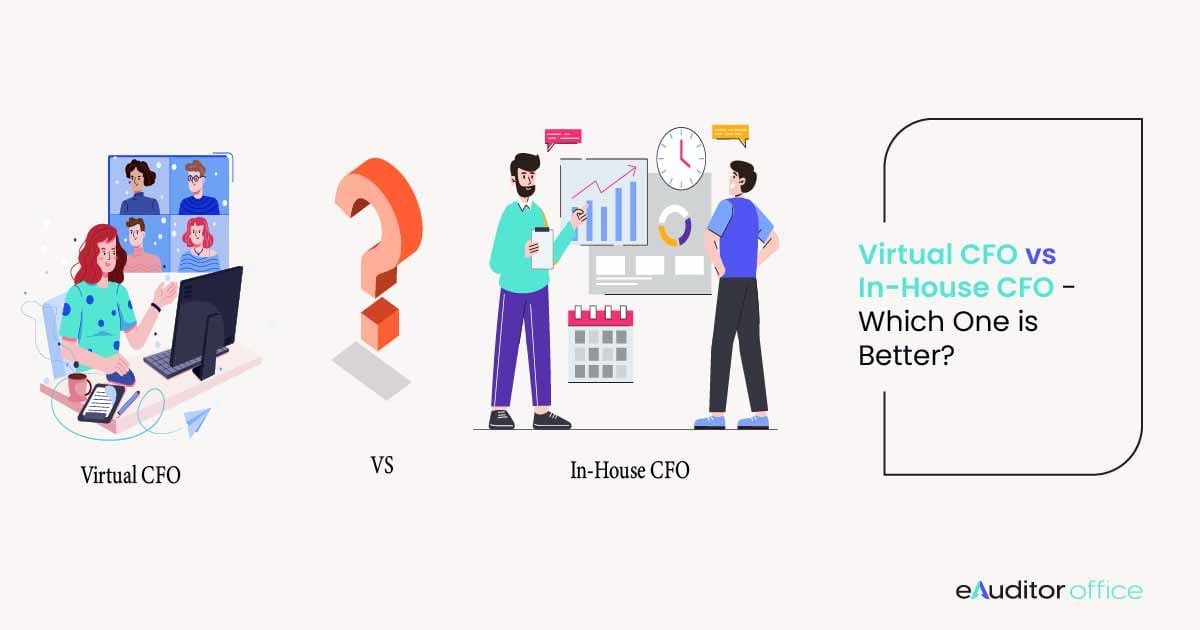
That’s the importance of CFO services in any company i.e., to charter the path to growth and expansion. That’s also the reason why virtual CFO services for startups are gaining prominence. However, not all businesses can afford full time CFO services in their company. That is where the virtual CFOs or fractional CFOs come into the picture. Virtual CFO services are far more affordable than the in-house CFO services in India. However, if you are thinking about who is better – virtual CFO vs in-house CFO, then let’s have a comparison between them!
Difference Between Virtual CFO vs In-House CFO
Here’s a comparative analysis between virtual CFO vs in-house CFO based on different parameters:
|
Parameters |
Virtual CFO |
In-House CFO |
|
Cost |
Virtual CFO services in India are very cost effective. This is because the virtual CFO pricing is far lower than in house CFO services and the fees only need to be paid services and deliverables availed of by the companies. |
In-house CFOs are full time salaried employees of the organisation. Further, they are in the top executive position. Therefore, in-house CFOs are paid heavily by the companies for the services they provide. That makes them expensive as compared to virtual CFOs. |
|
Flexibility |
Companies get to decide what services they need to avail of from the virtual CFOs. The services can be continuous or even assignment or project-based. This offers a lot of flexibility to companies hiring virtual CFOs. |
As stated earlier, in-house CFOs are full time employees of a company. Therefore, they are actively involved in the management. Even if the company doesn’t avail of the services of full tile CFOs, they are paid the remuneration. This reduces the flexibility available to the company. |
|
Experience |
As fractional CFOs work on a client-based model, therefore, they have clients from different industries. Thus, they hold rich knowledge and experience in multiple industries. |
In-house CFOs are deeply experienced in the industries that they have served. However, as in-house CFOs are committed to the companies they are employed in, therefore, their experience might be limited to 3-4 industries. While they may have depth, they might struggle with the width when it comes to experience. |
|
Network |
Over the years working with different industry clients and solving different problems for each of their clients, virtual CFOs build a strong network. This network in turn is helpful for channelizing the growth of their different clientele. |
In-house CFOs may create a network in the industry in which they operate. However, they might not be having as wide a network as a virtual CFO holds. |
|
Adaptability |
Virtual CFOs are more adaptable to different industries and challenges. There is a high chance that the problem that your business is facing might already have been solved by the virtual CFOs for their other clients. This is of immense help for your business. Further, as virtual CFOs are working on different projects with different companies, therefore, they are great multi-taskers. This is one of the major benefits of virtual CFOs for startups. |
When it comes to hiring full time employees, it takes time and effort on the part of the organisation to train and introduce them to the business of the organisation. Thus, it may take time for the in-house CFO to adapt to the organisation and the changing needs. |
|
Multiple Services |
While fractional CFOs can provide great financial services, their role is not limited to that. A company can avail of different services of virtual CFOs including but not limited to bookkeeping, reporting, financial management, budgeting, risk assessment, cost control, strategizing growth etc. This is also the reason why virtual CFOs for small businesses are gaining popularity. |
In-house CFOs mostly perform the roles assigned to them by the organisation. They cannot oversee multiple functions within an organisation as in the case of virtual CFOs. |
|
Team Benefit |
Virtual CFOs are a team of professionals providing virtual CFO services. Therefore, what virtual CFOs bring to the table are a team with diversified experience, knowledge and capabilities. This enables them to handle more tasks efficiently and provide more expertise. |
An in-house CFO is a single person with in-depth knowledge and expertise. Thus, while the organisation benefits from the experience and knowledge of the virtual CFO, it is the benefit tied to a single person. Organisations lose on team benefits that virtual CFOs can provide. |
Which CFO is Better For You?
The above points address some of the major differences between virtual CFO vs in-house CFO. It can be observed that virtual CFO services hold far more benefits as compared to an in-house CFO especially in the case of small and mid-size businesses. They are affordable, offer more flexibility, can provide multiple services and help provide better reach through their network. Further, as in-house CFO services are provided by top level executives, it is not possible for every business to hire an in-house CFO. Thus, if you are a small or midsize business, then it’s time you avail of best virtual CFO services with your eAuditor Office