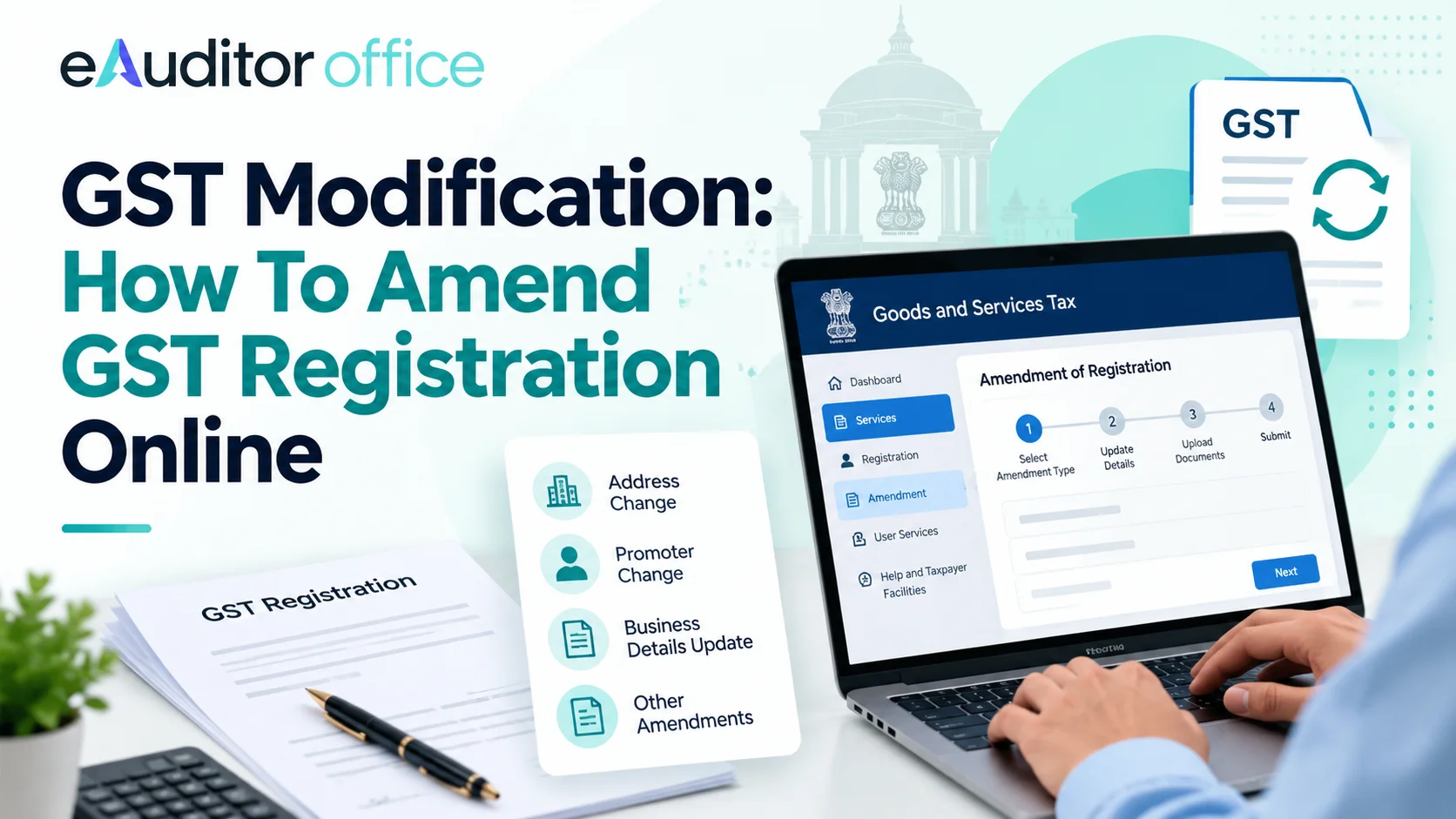
GST modification means updating the particulars of an existing GST registration. Businesses generally apply online using Form GST REG-14. Core changes require officer verification, while non-core changes usually update without officer approval after successful filing and any required authentication.
You may need an amendment after moving premises, changing the business name or appointing a new authorised signatory. However, some changes require fresh registration. The first step is identifying which route applies before editing the GST profile.
This guide explains the differences, supporting documents, filing process and timelines so you can prepare the right application.
Unsure whether your change needs an amendment or fresh registration? Explore eAuditor Office’s GST Modification service and discuss the proposed change before filing.
When Is GST Modification Required?
Review your registration whenever the information originally submitted changes. Common triggers include a new business address, an additional warehouse, changes in persons responsible for the business, and updated contact or bank details.
Registration amendments are governed by Rule 19 of the CGST Rules, 2017. The general requirement is to submit the amendment application within 15 days of the change, with documents supporting it. This is different from the officer’s processing period, which is expressed in working days.
Do not wait until the next GST return to review a registration change. Keep the underlying event date, application record and supporting evidence together.
What Are Core And Non-Core Amendments?
The distinction concerns the approval process. Calling a field “non-core” does not mean the information is unimportant.
| Change | Normal Amendment Route |
| Legal name of the business, with the same PAN | Core |
| Trade name | Core portal workflow |
| Principal place of business within the same state | Core |
| Additional place of business within the same state | Core |
| Addition, deletion or retirement of specified partners, directors or other responsible persons | Core |
| Authorised signatory or contact details | Non-core, subject to verification |
| Bank account details | Non-core, subject to portal validation |
| Business PAN or relocation of the registration to another state | Fresh-registration assessment required |
The GST portal treats a trade-name change as core because it triggers an updated registration certificate. For a signatory who is also a director or partner, assess both roles: changing signatory authority and changing the underlying stakeholder are different updates.
Which Changes Require Fresh GST Registration?
Change In PAN
An existing GSTIN cannot be amended to substitute another taxpayer PAN. Where a change in business constitution results in a different PAN, fresh registration is required. For example, converting a proprietorship into a company involves a different taxable person’s PAN.
Do not treat every business-constitution change as automatically identical. Confirm whether the PAN remains unchanged and whether the proposed update is permitted through amendment.
Change Of State
You cannot move an existing state-specific GST registration into another state by editing its address. Assess registration requirements in the destination state and the continuing obligations attached to the existing GSTIN.
Opening an additional branch in another state does not automatically mean the original registration must be cancelled. Cancellation, stock transfers and other transition matters require separate examination.
What Documents Are Needed For GST Modification?
Prepare evidence relevant to the particular change. There is no single document pack suitable for every amendment.
| Proposed Change | Documents To Prepare, As Applicable |
| Business name | Updated incorporation or name-change records and supporting approvals |
| Principal or additional premises | Ownership evidence, rent or lease agreement, consent and relevant premises proof |
| Partner or director | Appointment, retirement or reconstitution documents and required identity details |
| Authorised signatory | Authorisation letter or resolution and required identity/contact information |
| Bank account | Bank statement, cancelled cheque or other evidence accepted by the portal |
Treat this as a preparation checklist. Check the current upload requirements for your ownership or occupancy arrangement, taxpayer category and selected field. Names, addresses and dates should agree across the application and evidence.
How To Amend Core Fields On The GST Portal
Use the official GST portal and the registration amendment option for core fields. The usual workflow is:
- Log in at gst.gov.in using the registered account.
- Open Services, then Registration, then Amendment of Registration Core Fields.
- Select the relevant business, premises or stakeholder tab.
- Enter the revised information, date of amendment and reason.
- Upload the supporting documents requested for that change.
- Review all affected sections and complete verification.
- Submit using the authentication method applicable to your taxpayer category.
- Retain the acknowledgement and application reference for tracking.
Saving an application does not complete filing. Confirm that submission succeeded, then monitor the application rather than assuming that a saved draft has updated the registration.
How To Amend Non-Core Fields
Select Amendment of Registration Non-Core Fields under the Registration menu. Edit the permitted details, complete the requested checks and submit the application.
Non-core amendments generally do not require approval from a tax officer. Contact changes can nevertheless require OTP verification, while bank details may undergo validation. Follow the current prompts and complete verification within any period displayed by the portal.
After filing, inspect the updated profile. If changing the primary authorised signatory, confirm that the correct person has access to notifications and future filing responsibilities.
Avoid sharing login credentials or OTPs unnecessarily. Agree who will prepare the application and who will authorise submission before starting the process.
How Long Does GST Amendment Approval Take?
For specified core changes, Rule 19 provides an officer-verification and approval period of 15 working days from receipt of the application. Approval is issued through Form GST REG-15.
If the officer requires clarification, a notice may be issued in REG-03. The applicant must respond in REG-04 within seven working days of service of the notice. Unsatisfactory replies or failure to respond can result in rejection through REG-05.
These are statutory periods, not a promise that every application will finish on an identical date. Monitor notices and the portal status. Rule 19 also contains deemed-amendment provisions where the officer takes no action within the specified periods.
Do not assume you can freely backdate changes. Rule 19(1A) restricts amendments taking effect before the application date, except under a Commissioner’s reasoned order subject to its conditions. Review the applicable effective date where a past-period correction is involved.
Is Switching To Composition A Registration Amendment?
Composition scheme entry and withdrawal use separate procedures. Form GST REG-14 should not be treated as a substitute for them.
An eligible existing regular taxpayer generally opts for composition through GST CMP-02 before the start of the relevant financial year. Composition withdrawal uses GST CMP-04 under the applicable rules. Eligibility, timing and related credit adjustments need separate checks. The option did not permanently close on 31 March 2018.
Keep your GST registration aligned with your business records. Contact eAuditor Office for GST modification support to review the change, supporting documents and filing requirements.
What Should You Check After Filing?
Keep the application acknowledgement, documents, notices and final order in one record. Once processed, download the updated certificate where applicable and confirm that the amended particulars are correct.
Then review the business systems affected by the change: invoicing details, vendor records, bank records and internal compliance checklists. A registration amendment does not automatically correct previously filed returns or earlier invoices.
FAQs
Yes, an eligible address change within the same state can be filed through a core amendment. Moving the registration to another state requires a different registration assessment.
No. A different taxpayer PAN cannot be substituted through a registration amendment. Examine fresh registration and related transition requirements.
No. Core amendments require officer verification. Non-core updates generally proceed without officer approval after filing and the applicable authentication or validation.
An amendment to the existing registration generally retains its GSTIN. A fresh registration is a separate application and should not be confused with modifying the existing one.