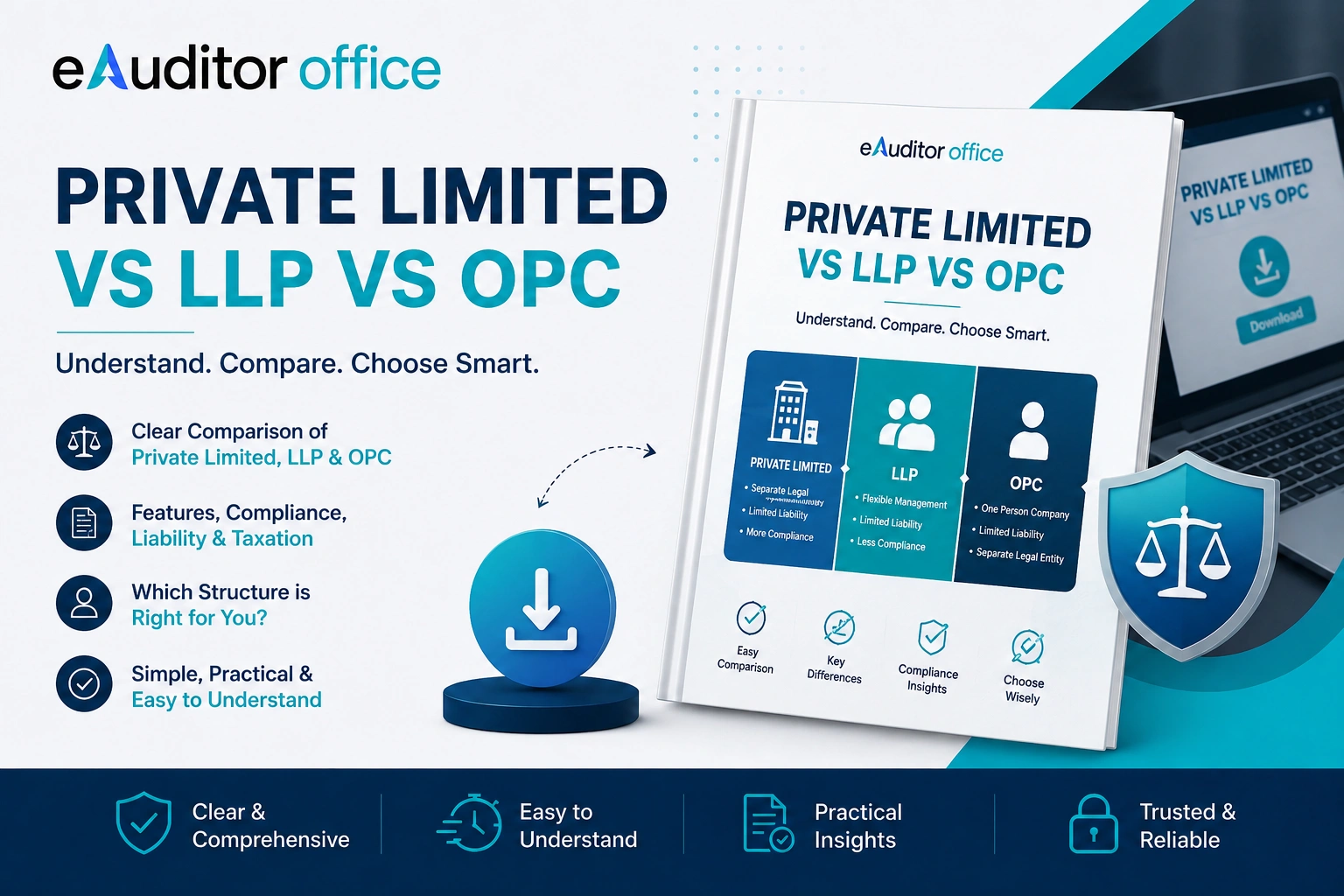
We get this question in almost every first call with a new founder: Pvt Ltd, LLP, or OPC? It looks like a small tick-box on the registration form and it rarely feels that way eighteen months in, when you’re mid-funding-round, or bringing on a partner, or just staring at a compliance bill that’s grown for reasons nobody explained upfront. This guide breaks down Private Limited vs LLP vs OPC on what genuinely moves the needle: liability, tax, funding access, and the paperwork you’ll be filing every single year. Not what looks simplest on the MCA portal today.
| Quick answerPlanning to raise venture capital or issue ESOPs → Private Limited Company.A service business with two or more partners who want low compliance → LLP.A solo founder who wants a company (not a proprietorship) without a co-founder → OPC. |
Thinking of starting your business solo? Register your OPC with expert guidance today.
What Each Structure Actually Is Private Limited Company
A Private Limited Company is registered under the Companies Act, 2013, and regulated by the Ministry of Corporate Affairs (MCA). It needs at least two shareholders and two directors, and it can go up to 200 shareholders. Since it’s a separate legal entity, the company itself holds assets, signs contracts, and carries debt, not its owners personally. Shareholder liability stops at the value of their shares. Investors default to this structure for a simple reason: shares are easy to transfer, and equity can be structured cleanly for funding rounds and ESOP pools.
Limited Liability Partnership (LLP)
An LLP sits somewhere between a traditional partnership and a company. It’s governed by the LLP Act, 2008, needs a minimum of two partners, and gives each partner limited liability, so personal assets stay protected beyond whatever they’ve put in. What it doesn’t have is share capital. No ESOPs, and no clean way to bring in an equity investor. In return, you get a noticeably lighter compliance load and an exit process that’s simpler than winding up a company.
One Person Company (OPC)
An OPC lets one person incorporate a company without roping in a co-founder just to satisfy a two-shareholder rule. It’s legally classified as a private company, so it carries the same limited liability and separate legal identity, just with one member and one nominee instead of the usual minimum. The 2021 amendment removed the old restriction that forced conversion to a Private Limited Company once paid-up capital crossed ₹50 lakh or turnover crossed ₹2 crore, so an OPC can scale today without being pushed into a structural change it isn’t ready for. Residency rules loosened too: the member or nominee now needs 120 days in India in the preceding financial year, down from 182. Foreign nationals still can’t form one.
Private Limited vs LLP vs OPC: Side-by-Side Comparison
| Feature | Private Limited Company | LLP | OPC |
| Minimum members | 2 shareholders, 2 directors | 2 partners | 1 member + 1 nominee |
| Maximum members | 200 shareholders | No limit | 1 (by design) |
| Governing law | Companies Act, 2013 | LLP Act, 2008 | Companies Act, 2013 |
| Liability | Limited to share value | Limited to agreed contribution | Limited to share value |
| Can raise equity funding | Yes, investor favourite | No, cannot issue shares | No external equity |
| Can issue ESOPs | Yes | No | No |
| Foreign ownership | Allowed (FDI rules apply) | Allowed (FDI rules apply) | Only resident Indian citizens |
| Statutory audit | Mandatory, every year | Only above ₹40L turnover / ₹25L contribution | Mandatory, every year |
| Approx. annual compliance cost | ₹30,000–50,000 | ₹10,000–20,000 | ₹15,000–25,000 |
| Exit route | STK-2 strike-off (document-heavy) | Form 24 strike-off (simpler, faster) | STK-2 strike-off (document-heavy) |
Starting a business with partners? Set up your LLP with simple, hassle-free registration support.
Tax Treatment: Where the Real Difference Shows Up
Founders tend to treat tax as an afterthought next to liability protection and funding access. It shouldn’t be. How a company and an LLP are taxed on distributed profit differs enough to flip which structure actually costs less, and the deciding factor is simply how much profit leaves the business each year versus how much stays in it.
| Structure | Applicable rate (FY 2026-27) | Double taxation on profit distribution? |
| Private Limited (normal regime) | 25% (turnover ≤ ₹400 Cr) or 30%, plus surcharge & cess | Yes — dividends taxed again in shareholders’ hands |
| Private Limited (concessional regime) | 22% base, ~25.17% effective (Sec 115BAA / Sec 200 of the new Act) | Yes — same dividend taxation applies |
| OPC | Same options as Pvt Ltd (normal or concessional) | Yes — treated as a company for tax purposes |
| LLP | Flat 30%, ~31.2% effective with cess | No — partner profit share is tax-exempt in their hands |
Here’s the part that trips people up: a Private Limited Company (or OPC) gets a lower headline rate under the concessional regime, but profit paid out as dividends gets taxed a second time in the shareholder’s hands. An LLP pays a flat 30%, about 31.2% effective once cess is added, but that’s the only bite. Partners draw their profit share afterward with nothing further owed on it. If you’re reinvesting most of what you earn, the company’s lower base rate usually wins out. If you’re running a business built to pay its owners every year, a consultancy, an agency, a professional practice, the LLP’s single layer of tax often comes out ahead. Sometimes by a wide margin.
A quick note on the numbers above: what’s commonly known as Section 115BAA under the Income-tax Act, 1961 has been renumbered to Section 200 under the Income-tax Act, 2025, which took effect on 1 April 2026 and governs FY 2026-27 onward. The rate itself, 22% base with the 25.17% effective outcome, hasn’t changed, only the section number has. LLPs also carry a separate Alternate Minimum Tax at 18.5% of adjusted total income, which applies if the regular 30% computation comes out lower than that. It rarely bites smaller firms, but it’s worth having your CA check before you assume the flat rate is the final word.
Matching the Structure to the Business
Choose Private Limited if
- You’re raising, or plan to raise, angel or VC funding
- You need to issue ESOPs to attract early employees
- You expect multiple funding rounds and want clean equity structuring
- Investor and lender credibility matters more than compliance cost
Choose LLP if
- You’re a professional practice: consulting, design, accounting, legal, architecture
- External equity funding isn’t part of the plan
- Keeping annual compliance cost and paperwork low is a priority
Choose OPC if
- You’re a solo founder who doesn’t want to add a placeholder co-founder
- You want limited liability and a real corporate identity, not a proprietorship
- You aren’t seeking outside equity investors in the near term
- You may want to convert to a Private Limited Company later, once you bring in a co-founder or investor
FAQs
Legally, yes. An OPC is classified as a private company and gets the same core benefits: separate legal identity and limited liability. The difference is purely structural, one member instead of the two-shareholder minimum a standard Private Limited Company needs.
LLPs usually come out cheapest, mostly because statutory audit only kicks in once turnover crosses ₹40 lakh or capital contribution crosses ₹25 lakh. Private Limited Companies and OPCs don’t get that exemption. They face mandatory annual audit regardless of size, and that shows up in the yearly bill.
Not in the way most investors expect. LLPs can’t issue shares, so standard equity funding is off the table. OPCs can’t bring in outside shareholders while keeping their OPC status. If institutional funding is on your roadmap, register as, or convert to, a Private Limited Company before that conversation happens, not after.
Yes. OPC to Private Limited, LLP to Private Limited, and a few other paths are all possible, but none of them happen overnight. Expect board approvals, regulatory sign-off, and extra cost. It’s usually cheaper to incorporate in the structure that fits your plan for the next two or three years than to convert later.
No. The LLP Act, 2008 requires a minimum of two partners to incorporate an LLP. If you want limited liability without hunting for a co-founder, an OPC is the structure to look at instead.