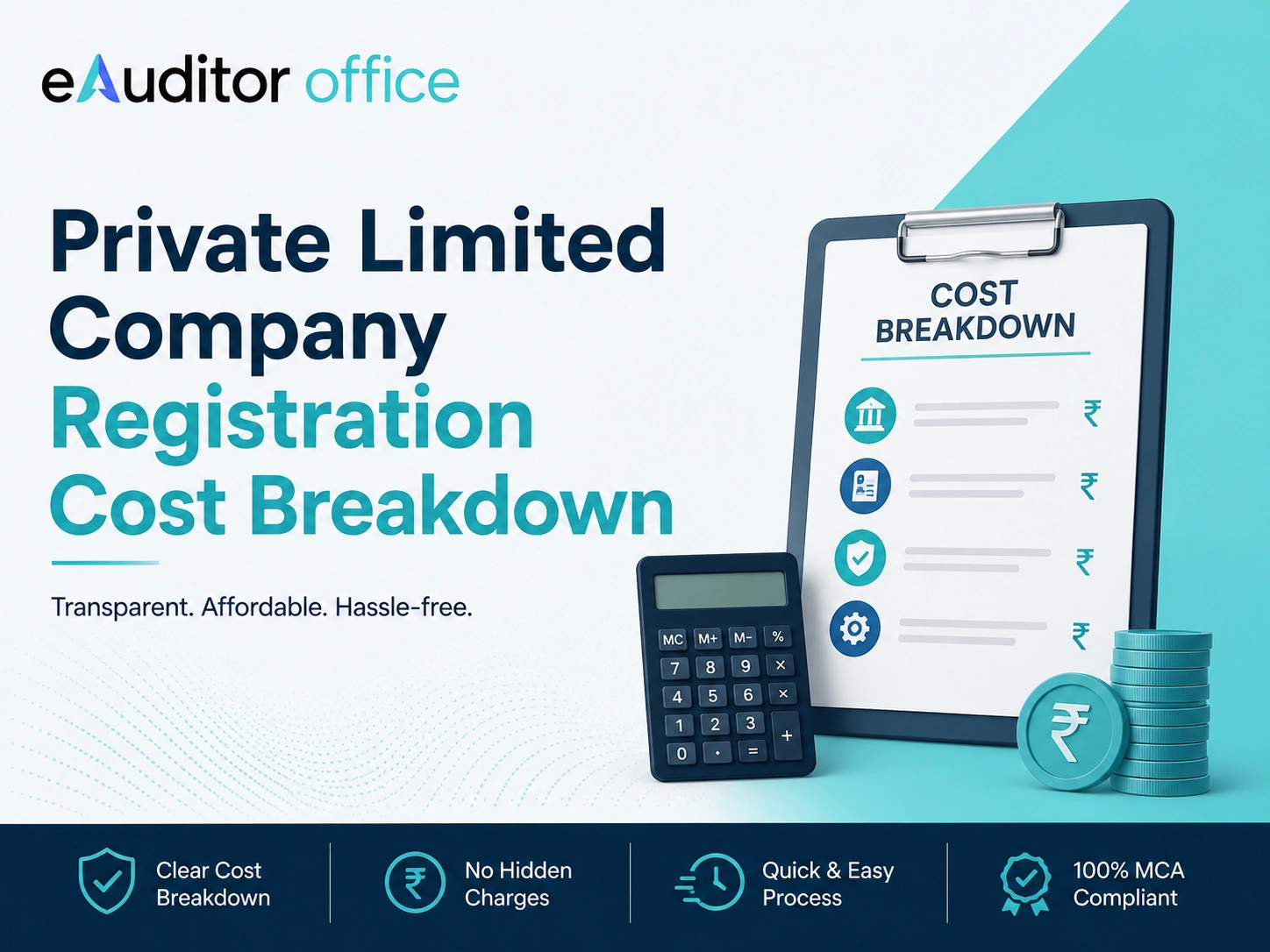
Registering a Private Limited Company in India in 2026 typically costs between ₹7,000 and ₹25,000 all-inclusive for a standard two-director setup with ₹1–10 lakh authorised capital. The exact number depends on three things: which state you’re registering in, how much authorized capital you declare, and whether you’re doing the paperwork yourself or paying a professional. Below is every cost component broken down, so nothing shows up as a surprise at the SPICe+ payment gateway.
Key Takeaways
Here’s the full cost picture at a glance before we get into the details of each component:
- Name reservation: ₹1,000
- Stamp duty (MOA + AOA): ₹200 – ₹12,600, depending on state
- Digital Signature Certificate: ₹1,500 – ₹2,500 per director
- PAN, TAN, DIN: free, bundled into SPICe+
- Professional fees (CA/CS): ₹5,000 – ₹15,000
- Total for a typical two-director company: ₹7,000 – ₹25,000
Why the Government Filing Fee Is Often Zero
Here’s something a lot of founders don’t realise until they’re staring at the SPICe+ payment screen: the MCA doesn’t charge a form filing fee at all if your authorised capital stays under ₹15 lakh. That threshold covers the overwhelming majority of new private limited companies — most startups begin with ₹1 lakh to ₹10 lakh in authorised capital, well inside the free zone.
Cross ₹15 lakh, though, and a graduated fee kicks in based on the capital slab you’ve declared. This is exactly why registering with an inflated authorised capital “just in case” is a mistake — it pushes up not just this fee, but stamp duty and annual RoC charges down the line too. Start with what you actually need. You can always increase it later through Form SH-7.
Private Limited Company Registration Made Simple — Get transparent cost guidance and end-to-end registration support from e-Auditor Office. Get Started Today.
Stamp Duty: The Real Wildcard
If there’s one line item that makes two founders’ registration bills look completely different, it’s stamp duty. This is a state-level tax charged on your Memorandum of Association and Articles of Association, and every state sets its own rate under its own Stamp Act.
Some states charge a flat amount regardless of capital. Others calculate it as a percentage. A few examples for ₹1 lakh authorised capital:
- Maharashtra — around ₹200
- Karnataka — a flat ₹500
- Delhi — roughly ₹150 (0.15% of capital)
- Tamil Nadu — around ₹1,000 (1% of capital)
- Himachal Pradesh — a flat ₹100
At higher capital slabs, the gap widens fast. In Maharashtra, MOA stamp duty alone climbs from ₹200 at ₹1 lakh capital up to ₹10,000 once you cross ₹1 crore. The SPICe+ portal calculates the exact figure automatically once you enter your state and capital amount, so there’s no need to work it out by hand — just budget with the range in mind before you file.
Digital Signature Certificates (DSC)
Every proposed director needs a Class 3 DSC to sign the SPICe+ form, the MOA, the AOA, and all accompanying declarations electronically. Each certificate runs ₹1,500 to ₹2,500 and is valid for two years, so a three-director company is looking at ₹4,500 to ₹7,500 just for signatures. This is a genuinely non-negotiable cost — SPICe+ simply won’t accept a filing without valid DSCs attached.
What’s Actually Free
It’s worth knowing what you’re not paying for, because a surprising amount of the process is bundled at no cost:
- DIN (Director Identification Number) — allotted directly through SPICe+ for up to three directors, no separate fee
- PAN and TAN — auto-generated as part of the same filing
- Name reservation — technically ₹1,000, the one small exception on this list, but it covers up to two proposed names
Professional Fees: Where the Range Comes From
This is the component you have the most control over. CA and CS firms typically charge ₹5,000 to ₹15,000 for standard incorporation, covering MOA/AOA drafting, SPICe+ preparation and filing, and guidance through the stamp duty payment. More complex setups — multiple share classes, an ESOP pool built in from day one, or a detailed shareholders’ agreement — push this figure higher.
A few things worth knowing before you pick a provider:
- The government components (filing fee, stamp duty, DSC) are fixed no matter who you hire — you’re only negotiating the professional fee
- Get quotes from two or three firms before committing; a ₹15,000–₹25,000 quote for a straightforward two-director company is on the high side for what’s become a fairly standardised process
- Ask for a fixed-fee quote rather than hourly billing, so there’s no ambiguity if a name gets rejected and needs resubmission
Sample Cost Breakdown: Two-Director Company, Karnataka
To make this concrete, here’s what a typical filing looks like for a two-director company registering in Bangalore with ₹1 lakh authorised capital:
| Item | Cost |
|---|---|
| MCA filing fee | ₹0 |
| Name reservation | ₹1,000 |
| Stamp duty (Karnataka) | ₹500 |
| DSC (2 directors × ₹2,000) | ₹4,000 |
| Professional fees | ₹8,000 – ₹12,000 |
| Total | ₹13,500 – ₹17,500 |
Swap in a different state or a higher authorised capital, and the number moves mainly through stamp duty and the professional fee — the free components stay free.
Costs That Show Up After Incorporation
The Certificate of Incorporation isn’t the end of the spending. A few things follow within the first year that founders regularly forget to budget for:
- Form INC-20A (Declaration of Commencement of Business) — due within 180 days; filing itself is low-cost, but you can’t legally start operating without it
- First-year compliance — annual return filing, DIR-3 KYC, a statutory audit, and income tax return typically add ₹15,000 to ₹50,000 depending on transaction volume and whether you use a CA on retainer
- Bank account opening — usually free, but some banks require a minimum balance to activate a current account
Budgeting for incorporation alone and treating year-one compliance as an afterthought is one of the more common financial planning mistakes new founders make.
Common Ways Founders Overpay
- Rejections and resubmissions. A wrong object clause, a name too similar to an existing trademark, or mismatched director details all trigger an MCA rejection — and stamp duty already paid is non-refundable. Getting documents right the first time is the cheapest way to control cost.
FAQs
Between ₹7,000 and ₹25,000 all-inclusive for a standard two-director company with ₹1–10 lakh authorised capital, covering government fees, stamp duty, DSC, and professional charges.
Yes, for authorised capital up to ₹15 lakh. Above that threshold, a graduated fee applies based on the capital slab.
Because stamp duty on the MOA and AOA is set by each state’s own Stamp Act, not by the central government. Rates range from a flat ₹100–₹500 in some states to a percentage of authorised capital in others.
Yes. Every proposed director needs an individual Class 3 Digital Signature Certificate, typically ₹1,500 to ₹2,500 each, valid for two years.
With one director, the cheapest state, and no professional help, unavoidable government costs land around ₹3,000 to ₹5,000. Most founders still use a CA or CS to reduce the risk of rejection.