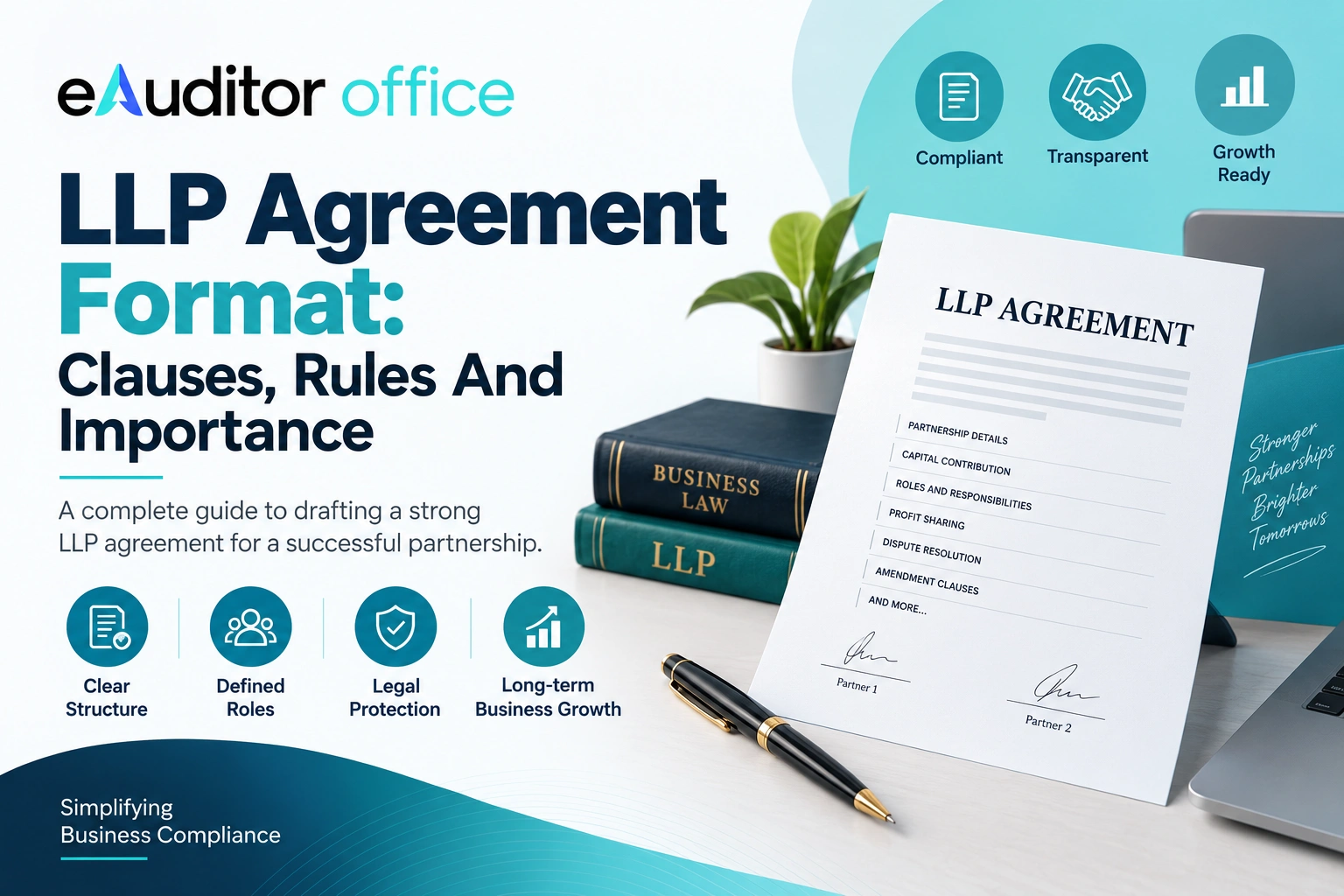
An LLP agreement is the document that explains how a Limited Liability Partnership will operate. It records what each partner will contribute, how profits and losses will be divided, who can make business decisions, and what happens when a partner joins, resigns or disputes a decision.
This agreement is not a document that should be copied from a random online template and signed without review. Every LLP has different partners, contributions, responsibilities and commercial goals. The LLP agreement format should reflect those actual arrangements.
Under Section 23 of the Limited Liability Partnership Act, 2008, the mutual rights and duties of partners are primarily governed by the LLP agreement. If the agreement does not address a particular matter, the default provisions in the First Schedule may apply. This is why a carefully drafted agreement is an important part of the LLP registration and post-incorporation process.
What Is An LLP Agreement?
An LLP agreement is a written contract between the partners of an LLP and, where applicable, between the LLP and its partners. It sets out the rules for ownership, management and internal administration.
A Limited Liability Partnership is a separate legal entity. However, the way its partners work together depends largely on the terms recorded in the agreement. The document may cover financial rights, operational authority, voting powers, duties, restrictions and procedures for handling future changes.
Section 23 of the Limited Liability Partnership Act, 2008 recognises the LLP agreement as the main document governing the relationship among partners. An agreement entered into before incorporation may also create obligations for the LLP if all partners ratify it after incorporation.
eAuditor Office can assist with LLP registration, agreement drafting support and related MCA filings. Get professional guidance to set up your LLP with clear partner terms and proper compliance from the beginning.
Is There A Standard LLP Agreement Format In India?
There is no single LLP agreement format that is suitable for every business. The contents depend on factors such as:
- The nature of the business
- The number of partners
- Each partner’s contribution
- The agreed profit-sharing ratio
- The role played by each partner
- Voting and management rights
- Industry-specific commercial risks
A basic online format may contain common clauses, but it may not protect the partners in situations such as non-performance, unauthorised withdrawals, partner incapacity, ownership of intellectual property or a deadlock between equal partners.
The agreement must comply with the LLP Act, applicable rules and other relevant laws. Clauses that conflict with mandatory legal provisions may not be enforceable merely because the partners have agreed to them.
What Must An LLP Agreement Contain?
The law provides flexibility in drafting an LLP agreement. Still, a practical and complete agreement should cover the following areas.
1. Name And Details Of The LLP
The agreement should mention the LLP’s approved name, LLP Identification Number, registered office address and date of incorporation. These details help connect the deed to the correct legal entity.
It should also identify every partner and designated partner, along with relevant address and identification details.
2. Business Activities And Objectives
The business clause should clearly describe the activities that the LLP intends to carry on. If the clause is too narrow, the LLP may need to amend its agreement whenever it enters a related business area. If it is too broad, the partners may disagree about which activities were originally authorised.
The stated business activities should remain consistent with the information submitted during LLP registration and with any sector-specific licences.
3. Capital Contribution Of Partners
The LLP agreement should state the contribution made or promised by each partner. A contribution may be in the form permitted by law, subject to applicable valuation and documentation requirements.
The clause should record:
- The amount or nature of each contribution
- The time within which it must be contributed
- Whether additional contribution may be required
- The approval process for changing contribution
- The consequences of delayed or unpaid contribution
- Whether interest will be payable on partner contributions
Clear contribution terms reduce the possibility of future disagreements about ownership and financial responsibility.
4. Profit And Loss-Sharing Ratio
Partners should record the exact ratio in which profits and losses will be shared. This ratio does not necessarily have to be identical to the capital contribution ratio, provided the commercial arrangement is lawful and properly documented.
The agreement should also explain when profits may be distributed, whether the LLP must retain working capital, and how drawings or advances taken by partners will be adjusted.
If the agreement is silent, default provisions may apply. Those default terms may not match what the partners intended.
5. Rights, Duties And Responsibilities Of Partners
A good LLP agreement format assigns clear responsibilities. It may specify who will handle finance, sales, operations, client relationships, regulatory filings or employee management.
It should also set standards for:
- Acting honestly and in the LLP’s interest
- Maintaining business records
- Protecting confidential information
- Avoiding conflicts of interest
- Disclosing personal interests in transactions
- Using LLP funds and property properly
- Complying with statutory requirements
This prevents a common problem in small businesses: every partner assumes that someone else is responsible for an important task.
6. Management And Decision-Making
The agreement should separate day-to-day decisions from major business decisions. Routine matters may be decided by designated partners or by a majority vote. Important matters may require unanimous consent or a higher voting threshold.
Major decisions commonly include:
- Admission or removal of a partner
- Borrowing above a specified limit
- Opening or closing a branch
- Changing the nature of the business
- Selling significant assets
- Amending the LLP agreement
- Closing or restructuring the LLP
The voting clause should explain whether voting power is equal or linked to contribution or profit share. It should also include a method for resolving a deadlock.
7. Remuneration, Interest And Reimbursement
If working partners will receive remuneration, commission, bonus or interest, the agreement should authorise it and explain how it will be calculated. It should also cover reimbursement of genuine business expenses.
Tax treatment may depend on the wording of the agreement and applicable income-tax provisions. The clause should therefore be reviewed by a qualified tax or legal professional.
8. Bank Accounts And Financial Controls
The agreement should identify who may open and operate bank accounts, approve payments and sign financial documents. It may set joint-signature requirements or transaction limits for better control.
It should also state the accounting year, method of maintaining books, access rights of partners, audit responsibilities and approval process for annual accounts.
9. Admission Of A New Partner
The agreement should explain how a new partner can join the LLP. It may cover eligibility, approval requirements, contribution, profit share, voting rights and execution of a supplementary agreement.
Without a defined process, bringing in a new investor or operating partner can become unnecessarily complicated.
10. Retirement, Resignation, Death Or Removal
A complete agreement must deal with partner exits. It should specify:
- The required notice period
- How the outgoing partner’s interest will be valued
- The payment timeline
- Treatment of pending profits, losses and liabilities
- Continuing confidentiality obligations
- Handover of records and business property
- Restrictions on using the LLP’s name or client information
The agreement should also explain what happens if a partner dies, becomes insolvent, loses legal capacity or seriously breaches the agreement.
Removal or expulsion clauses require careful drafting. The grounds and procedure should be specific, fair and consistent with applicable law.
11. Intellectual Property And Confidentiality
For consulting firms, technology businesses, agencies and professional service LLPs, intellectual property can be more valuable than physical assets.
The agreement should clarify whether trademarks, software, designs, databases, domain names, client materials and work created by partners belong to the LLP. It should also protect confidential business information during and after a partner’s association with the LLP.
12. Non-Compete And Conflict-Of-Interest Terms
The document may restrict partners from diverting business opportunities, using confidential information or operating competing businesses while they remain partners.
Post-exit restrictions must be drafted carefully because broad restraints on trade may not always be enforceable under Indian law. Confidentiality, intellectual property and non-solicitation clauses should be precise rather than excessive.
13. Indemnity And Liability
The agreement should state when the LLP will indemnify a partner for actions properly taken on its behalf. It should also deal with losses caused by fraud, wilful misconduct, unauthorised acts, gross negligence or breach of the agreement.
Limited liability does not protect a person from liability for their own wrongful act or fraud. Partners should understand this distinction before signing.
14. Dispute Resolution
The dispute-resolution clause should set out a practical process. Partners may first attempt negotiation or mediation before moving to arbitration or court proceedings.
If arbitration is selected, the agreement should specify the seat, language, appointment method and applicable rules. Clear drafting can save considerable time and expense when a dispute occurs.
15. Amendment, Closure And Winding Up
Businesses change. The agreement should state how it may be amended and what level of partner approval is required.
It should also address voluntary closure, settlement of liabilities, recovery of receivables, sale of assets and distribution of the remaining balance among partners.
What Happens If There Is No LLP Agreement?
If partners do not agree on a matter, the relevant provisions of the First Schedule to the LLP Act may govern their rights and duties.
These default provisions include equal sharing of capital, profits and losses; equal participation in management; no automatic remuneration for taking part in management; and a requirement for all existing partners to consent to the admission of a new partner.
Those rules may be unsuitable where partners contribute different amounts, work for different periods or require different voting rights. A written agreement allows partners to replace many default rules with terms that fit their actual business arrangement.
LLP Agreement Stamp Duty And Execution
An LLP agreement is generally executed on stamp paper or through another legally recognised stamping method. Stamp duty is governed by the applicable state stamp law, so the amount can vary based on the state, capital contribution and nature of the instrument.
Partners should check the applicable rate instead of assuming that one stamp-duty amount applies throughout India. Inadequate stamping may affect the document’s admissibility or require payment of deficient duty and penalties.
After finalisation, the agreement should be signed by the partners and witnessed as required. Each partner should retain access to the executed version.
Filing The LLP Agreement Through Form 3
Rule 21 of the Limited Liability Partnership Rules, 2009 requires information about the initial LLP agreement to be filed with the Registrar in Form 3 within 30 days of incorporation. Changes to the agreement must generally be reported through Form 3 within 30 days of the change. The filing requirements appear in the Limited Liability Partnership Rules, 2009.
If a change also involves the admission, cessation or modification of a partner’s details, connected filings such as Form 4 may be required.
Late filing can lead to additional fees and compliance complications. The agreement should therefore be drafted, stamped, executed and filed without waiting until the last few days.
Common Mistakes To Avoid
Businesses often face problems because they:
- Copy an LLP agreement format without customising it
- Leave the partner contribution or profit ratio unclear
- Give equal voting rights without a deadlock mechanism
- Ignore partner exit and valuation provisions
- Fail to protect intellectual property and client data
- Use an incorrect stamp-duty amount
- Execute the deed but forget to file Form 3
- Change commercial terms without filing the amendment
- Use terms that conflict with the LLP Act or another applicable law
A short agreement is not necessarily a bad agreement. The real test is whether it clearly covers the arrangements and risks relevant to that LLP.
Why A Proper LLP Agreement Matters
A properly drafted agreement gives partners a shared rulebook. It records commercial expectations while everyone is in agreement, rather than leaving difficult questions to be negotiated after a dispute begins.
It also supports smoother banking, accounting, taxation, investment and compliance processes. Most importantly, it gives the LLP a governance structure suited to its business instead of relying on default statutory rules.
FAQs
The LLP Act allows the agreement to govern the rights and duties of the LLP and its partners, while Rule 21 requires information about the agreement to be filed in Form 3. If a matter is not covered by an agreement, the First Schedule may apply.
Information about the initial agreement should generally be filed within 30 days of incorporation. A change to the agreement should also generally be filed within 30 days of that change.
Yes. The partners may amend it according to the procedure and approval requirements stated in the existing agreement. The change should be properly documented, stamped where applicable and reported to the Registrar through the relevant filing.
The agreement should be executed by the parties whose rights and duties it governs. For initial and supplementary deeds, the required partners should sign according to the agreed terms and applicable legal requirements.
A downloaded format may be useful as a reference, but it should not be used without professional review. Generic templates often miss business-specific terms involving authority, exits, valuation, intellectual property and dispute resolution.