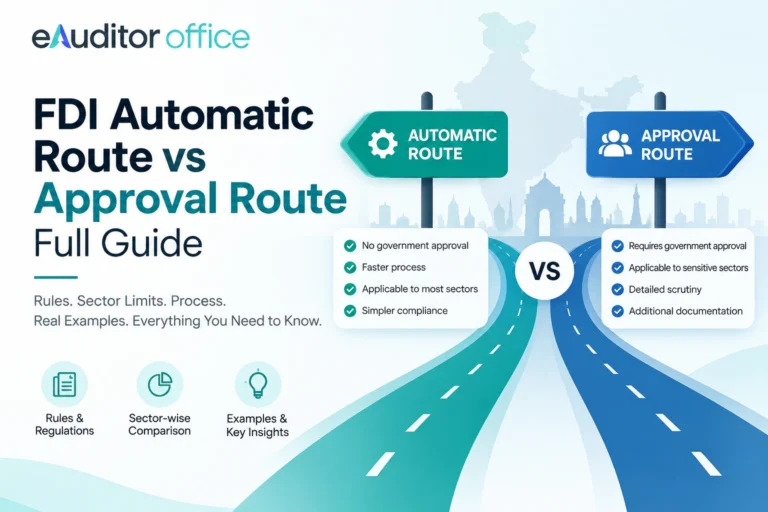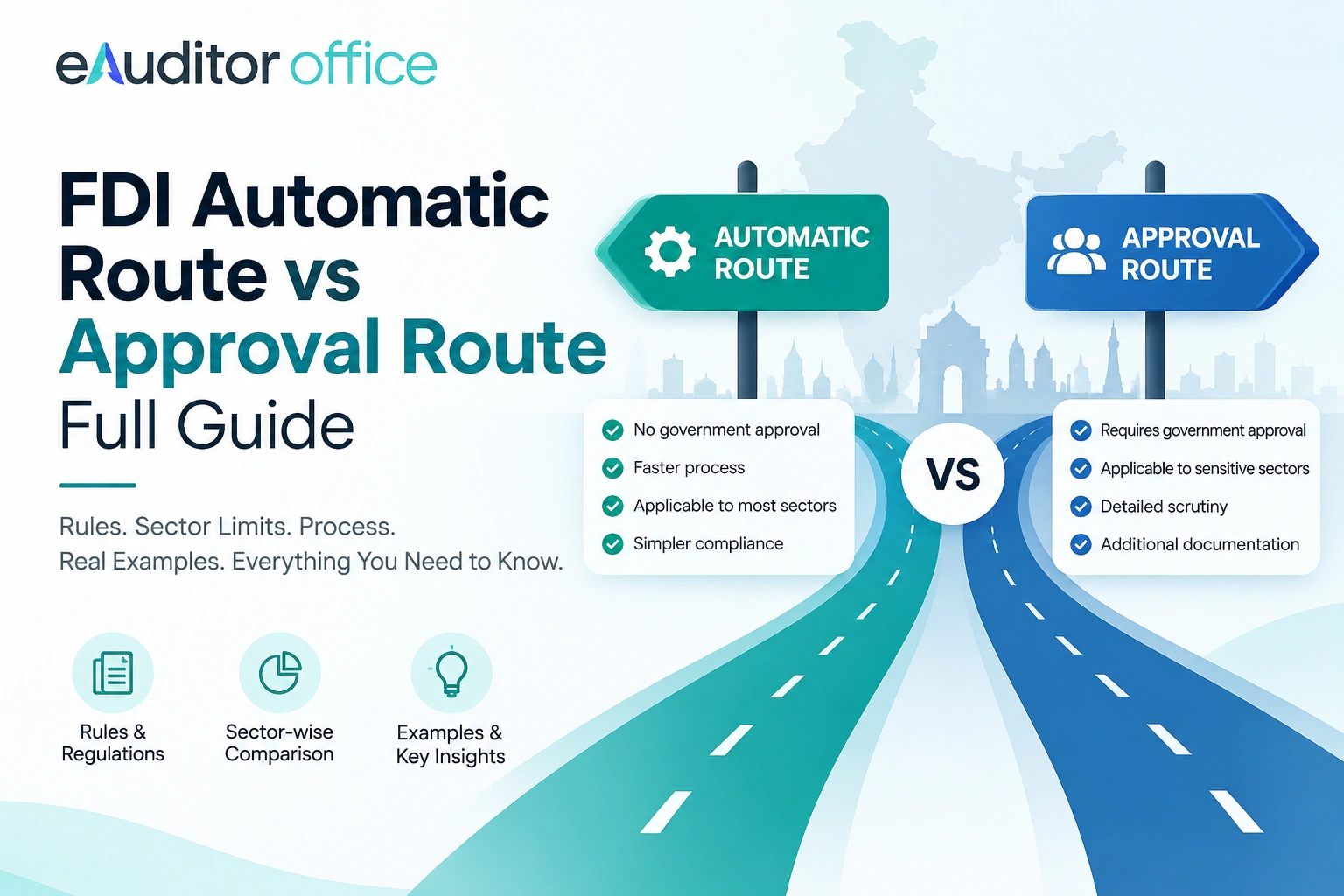
Foreign investors planning to enter India often come across two terms: the automatic route and the approval route. These routes determine whether an investor can proceed without prior government permission or must obtain approval before bringing foreign investment into the country.
The difference affects the incorporation structure, investment timeline, documentation and compliance process. Choosing the wrong route may delay the transaction and can also result in a violation of India’s foreign direct investment rules.
This guide explains the FDI automatic route vs approval route, with practical examples and the key checks businesses should complete before proceeding with Foreign Subsidiary Incorporation in India.
What Is The Automatic Route For FDI?
Under the automatic route, a foreign investor does not need prior approval from the Government of India to invest in an eligible Indian business.
The investment can proceed if:
- The business activity is permitted under the automatic route.
- The proposed foreign investment remains within the applicable sectoral cap.
- All sector-specific conditions are met.
- The investor and beneficial owners are eligible.
- FEMA, RBI, Companies Act and reporting requirements are followed.
No prior approval does not mean there is no compliance. The Indian company must still receive the funds through an authorised banking channel, issue the relevant capital instruments and complete the prescribed filings.
DPIIT lists several activities that permit up to 100% FDI under the automatic route, subject to their respective conditions. Examples include manufacturing, telecom services, greenfield pharmaceuticals, construction development and certain e-commerce activities. DPIIT’s sector list provides the applicable automatic-route caps.
What Is The Approval Route For FDI?
The approval route, also known as the government route, applies when prior permission from the Government of India is required.
The investor cannot complete the proposed investment first and seek routine approval later. Approval should normally be obtained before the investment is made or the relevant shares are transferred.
Government approval may be required when:
- The sector is specifically placed under the government route.
- The proposed investment exceeds the automatic-route limit for a sector.
- The investor or beneficial owner falls within a restricted category.
- The transaction results in foreign ownership or control where approval is required.
- A transfer, merger or restructuring triggers an approval condition.
Applications are filed online through the Foreign Investment Facilitation Portal or the connected National Single Window System. DPIIT identifies the relevant administrative ministry or department, which then examines the proposal. RBI, the Ministry of Home Affairs, the Ministry of External Affairs or another regulator may also be consulted where applicable. The current government SOP explains this review process.
FDI Automatic Route vs Approval Route: Key Differences
| Basis | Automatic Route | Approval Route |
| Prior government permission | Not required | Required |
| Applicable sectors | Sectors permitted under the automatic route | Restricted sectors or investment beyond automatic limits |
| Application before investment | No government FDI application | Online approval application required |
| Processing time | Usually faster, subject to incorporation and banking compliance | Longer because the proposal is examined by government authorities |
| Government review | No case-specific prior review | Proposal is reviewed by the competent ministry or department |
| Security clearance | Generally not part of a routine automatic-route investment | May be required for specified sectors or investors |
| Documentation | Incorporation, banking, valuation and FEMA reporting documents | Detailed proposal documents plus incorporation, ownership, financial and regulatory records |
| Post-investment filings | Mandatory | Mandatory even after approval is obtained |
| Transaction certainty | Higher when all policy conditions are clearly satisfied | Depends on approval and any conditions imposed |
| Best suited for | Permitted investments within automatic limits | Restricted investments and cases crossing automatic thresholds |
How To Determine The Correct FDI Route
The sector name alone is not enough to determine the entry route. A company must review the actual business activity, proposed ownership and investor background.
1. Identify The Exact Business Activity
Start by defining what the Indian company will do. A broad description such as “technology,” “financial services” or “online business” may not be sufficient.
For example, a software development company and an online marketplace may both use technology, but their FDI conditions can differ. Likewise, an unregulated consultancy is different from a business carrying out regulated financial services.
The company’s objects in its Memorandum of Association should match the permitted activity.
2. Check The Sectoral Cap
A sectoral cap is the maximum foreign investment allowed in a particular sector. Some activities allow 100% foreign investment, while others have lower limits.
A company should check:
- The total permitted foreign investment
- The portion permitted automatically
- The portion requiring government approval
- Conditions attached to foreign ownership or control
- Restrictions imposed by the relevant sector regulator
Foreign investment includes direct and indirect foreign investment. Looking only at the immediate shareholder can produce an incorrect calculation.
3. Review The Investor And Beneficial Ownership
The investor’s country of incorporation is important, but it may not be the only factor. The ownership and control behind the investor must also be examined.
India has special rules for investors and beneficial owners connected with countries that share a land border with India. Under the framework revised in 2026, government approval may be required based on the investor’s location, beneficial ownership or control. Certain other land-border-linked investments that do not cross the prescribed ownership or control tests may still face additional reporting requirements. The revised policy became operational through the related FEMA amendment referenced in the government SOP. DPIIT Press Note 2 of 2026 explains the revised beneficial-ownership framework.
This assessment should be completed before accepting funds or transferring shares.
4. Examine The Transaction Type
The route must be checked for the specific transaction. Relevant events may include:
- Rights issue or bonus issue
- Merger, demerger or amalgamation
- Conversion of an eligible instrument into equity
- Downstream investment by a foreign-owned Indian company
An activity that appears eligible under the automatic route may still require approval because of the way the transaction is structured.
Examples Of Automatic And Approval Route FDI
Example 1: Foreign-Owned Manufacturing Company
A German company wants to establish a wholly owned subsidiary in India to manufacture industrial equipment.
Manufacturing generally permits up to 100% FDI under the automatic route, subject to the applicable policy and laws. If the investor has no restricted beneficial ownership and the activity does not fall under another regulated sector, prior government approval may not be required.
The Indian subsidiary must still complete incorporation, receive funds through an authorised dealer bank, issue shares and file the required FEMA forms.
Example 2: Investment In A Defence Company
A foreign investor proposes to acquire 60% in an Indian company manufacturing defence equipment that requires an industrial licence.
The defence sector permits foreign investment up to a prescribed level under the automatic route, while investment above that level and up to the overall cap may require government approval and satisfaction of additional conditions.
The parties must confirm the latest applicable threshold, licensing requirements, ownership structure and security conditions before completing the transaction.
Example 3: Acquisition Of A Brownfield Pharmaceutical Company
A foreign pharmaceutical group wants to acquire 85% of an existing Indian pharmaceutical company.
Brownfield pharmaceutical investments follow a mixed entry route. Investment up to the automatic-route threshold may proceed without prior approval, while investment beyond that threshold and within the sectoral cap requires government approval.
Since the proposed acquisition exceeds the automatic limit, the investor would need approval before completing it.
Example 4: Investor With Restricted Beneficial Ownership
A foreign company incorporated in a country that does not share a land border with India proposes to invest in an Indian manufacturing business. However, its ownership structure includes a person or entity connected with a land-border country.
Manufacturing may ordinarily fall under the automatic route, but the investor-level restriction can change the route. The parties must review beneficial ownership and control under the current rules. Depending on the findings, prior approval or additional reporting may apply.
This example shows why sector eligibility and investor eligibility must be checked separately.
How The Government Approval Process Works
Where approval is required, the usual process includes the following steps:
- Prepare the investment structure and supporting documents.
- Submit the online FDI proposal through the prescribed portal.
- Complete security or regulatory review, where applicable.
- Receive the approval letter and examine its conditions.
- Bring in the investment and issue or transfer capital instruments.
- Complete RBI, FEMA and company-law filings.
The current SOP sets a standard cumulative processing framework of up to 12 weeks for approval after interdepartmental review. This timeline excludes delays caused by incomplete documents or time taken by the applicant to answer queries. Additional time may apply in certain cases, including proposed rejection, extra conditions or specified land-border-country investments. See the FIFP Standard Operating Procedure.
Documents Commonly Required For Approval Route FDI
The exact documents depend on the investor, investee and transaction. A proposal may require:
- Certificate of incorporation of the investor and Indian investee
- Memorandum and Articles of Association
- Board resolutions approving the investment
- Ownership and beneficial ownership details
- Audited financial statements
- Business plan and details of the proposed activity
- Proposed capital structure before and after investment
- Valuation report
- Investor identification documents
- Details of fund sources
- Sector-specific licences or approvals
- Security clearance form, where applicable
- Declarations and affidavits prescribed by the SOP
Incomplete ownership disclosures or inconsistent business descriptions are common reasons for questions from the reviewing authority.
Does The Automatic Route Remove FEMA Reporting?
No. Both routes remain subject to post-investment compliance.
Depending on the transaction, the Indian company or reporting party may need to complete filings such as:
- Form FC-GPR: For the issue of capital instruments to a person resident outside India.
- Form FC-TRS: For certain transfers of capital instruments between residents and non-residents.
- Annual FLA Return: For Indian companies and LLPs that have received qualifying foreign investment.
- Downstream Investment Reporting: Where a foreign-owned or controlled Indian entity invests in another Indian entity.
- Single Master Form Filings: Through the RBI FIRMS portal, as applicable.
Approval under the government route does not replace these filings. It only authorises the proposed investment subject to stated conditions. Pricing rules, payment methods, reporting deadlines and sector-specific compliance must still be followed.
Common Mistakes Businesses Should Avoid
Businesses should avoid assuming that every 100% foreign-owned company qualifies automatically. The permitted percentage and the applicable entry route are separate questions.
Other common mistakes include:
- Using a broad or incorrect business activity classification
- Accepting funds before obtaining required approval
- Ignoring indirect foreign investment
- Failing to examine beneficial ownership
- Missing FC-GPR or FC-TRS reporting
- Assuming company incorporation itself amounts to FDI approval
- Overlooking conditions imposed by a sector regulator
These issues are easier to prevent before incorporation than to correct after the investment has been received.
Get Help With Foreign Subsidiary Incorporation
Planning a foreign-owned business in India involves more than registering a company. The entry route, sectoral cap, beneficial ownership, shareholding pattern and FEMA reporting must all work together.
E-Auditor can assist with Foreign Subsidiary Incorporation, supporting documentation and related regulatory filings. Get professional help to structure your Indian subsidiary correctly and complete the incorporation process with fewer compliance gaps.
Conclusion
The central difference in the FDI automatic route vs approval route is prior government permission. An eligible automatic-route investment can proceed without case-specific approval, while an approval-route transaction must be cleared by the competent authority before completion.
That distinction is only the starting point. Businesses must also check the sectoral cap, investor’s country, beneficial ownership, transaction structure, pricing rules and post-investment filings. A careful review before funds enter India can prevent approval delays, reporting defaults and expensive restructuring later.
FAQs
Prior RBI or government approval is generally not required for an eligible automatic-route investment. However, FEMA conditions, banking checks and RBI reporting requirements still apply.
Yes, 100% foreign ownership is permitted in many sectors under the automatic route. The result depends on the business activity, investor eligibility, sectoral cap and applicable conditions.
Where the government route applies, the proposed investment should not be completed before receiving approval. The transaction must follow the approval letter and applicable FEMA requirements.
Yes. In the context of FDI in India, “approval route” is commonly used to refer to the government route.
Neither route is universally better. The correct route is the one prescribed for the proposed sector, investment level, investor profile and transaction. The automatic route is usually faster, but it can be used only when all eligibility conditions are met.