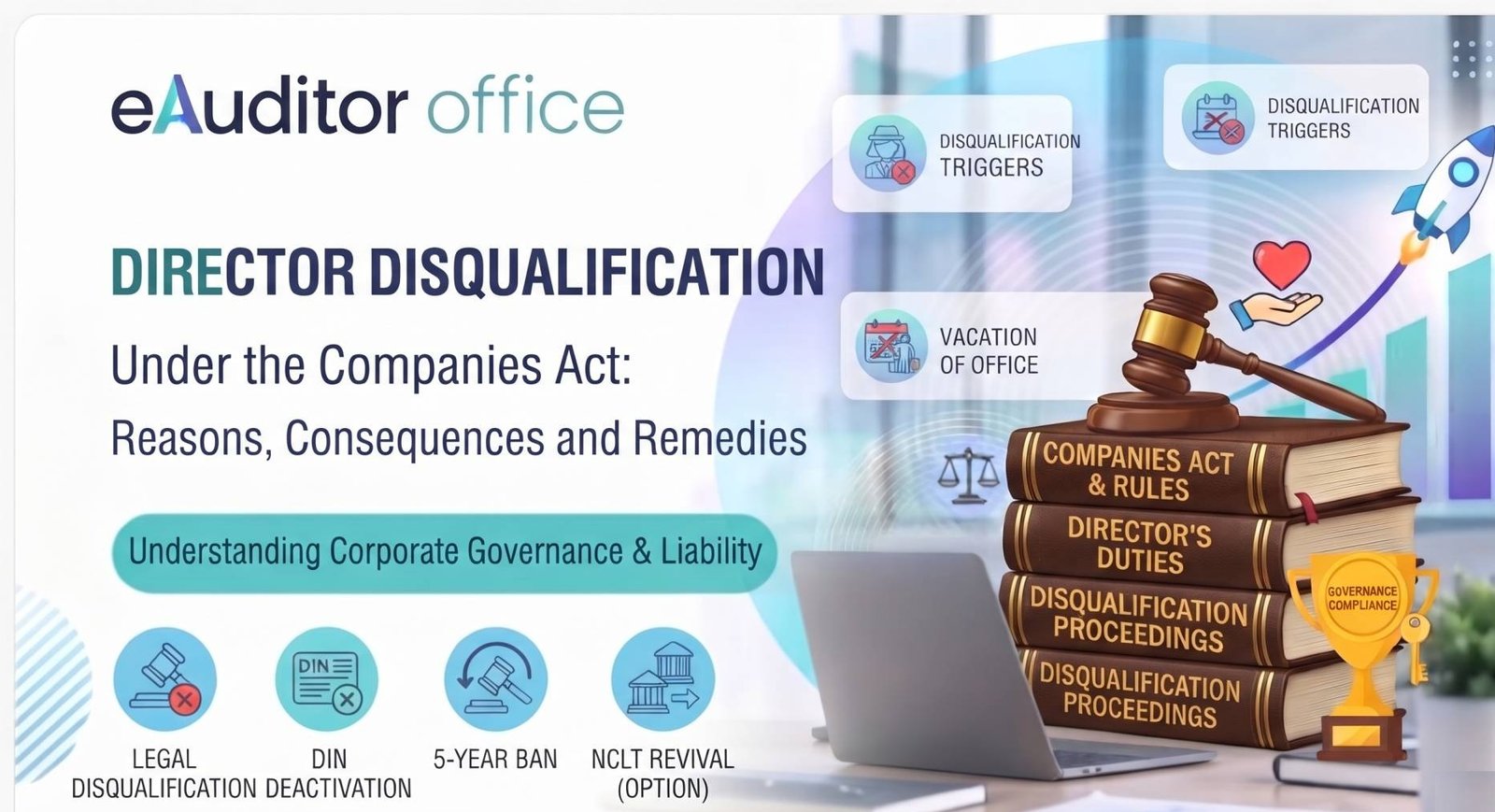
Serving on a company’s board carries strict statutory responsibilities under the Companies Act, 2013. When a company defaults on core regulatory filings or financial obligations, the Ministry of Corporate Affairs (MCA) enforces accountability by disqualifying its directors and deactivating their Director Identification Numbers (DIN).
Primary Reasons for Director Disqualification
Under Section 164 of the Companies Act, 2013, disqualification occurs on either personal or corporate default grounds:
- Non-Filing of Annual Returns (Section 164(2)(a)): The most common trigger—where a company fails to file financial statements (Form AOC-4) or annual returns (Form MGT-7/MGT-7A) for any continuous period of three financial years. Maintaining disciplined annual ROC compliance keeps filings on schedule and protects board members.
- Financial Defaults (Section 164(2)(b)): Where a company fails to repay accepted deposits, pay interest thereon, redeem debentures, or pay declared dividends, and such failure continues for one year or more.
- Personal Grounds (Section 164(1)): Being declared of unsound mind by a competent court, being an undischarged insolvent, conviction for an offence involving moral turpitude with imprisonment of six months or more, or holding directorships in more than 20 companies (maximum 10 public companies) under Section 165.
(Note: Disqualification under Section 164 is distinct from temporary DIN deactivation caused by missing the annual DIR-3 KYC filing deadline of September 30.)
Severe Consequences of Disqualification
- Five-Year Ban: A director disqualified under Section 164(2) cannot be reappointed in the defaulting company or appointed as a director in any other company for five years from the date of default—a restriction that directly impacts any future appointment of a director.
- Immediate Vacation of Office (Section 167(1)(a)): The disqualified individual must immediately vacate their directorship in all other compliant companies where they hold office. Under the proviso to Section 167(1)(a), they retain office only in the defaulting company solely to complete pending statutory filings.
- Penal Liability: Continuing to act as a director while knowing the office has become vacant attracts imprisonment up to one year, a fine between ₹1 lakh and ₹5 lakh, or both.
Legal and Compliance Remedies
Once triggered under Section 164(2), disqualification is automatic and cannot simply be reversed by filing late forms if the company is still active—it runs for the full five-year term. However, specific remedies exist depending on the company’s status:
- If the Company Is Active: File all overdue financial statements and annual returns with additional late fees to bring the company into compliance, preventing further strike-off proceedings.
- If the Company Was Struck Off (Section 252): File a petition before the National Company Law Tribunal (NCLT) for company restoration. Once the NCLT orders revival and the ROC reactivates the company, file all pending annual returns. If you are winding down operations intentionally, follow proper procedures for closing a private limited company instead of letting filings lapse.
- Writ Petition Before the High Court: If disqualification was applied erroneously (for instance, against a director who had already resigned before the default occurred, or without following principles of natural justice), the director can file a writ petition before the jurisdictional High Court seeking a stay or quashing of the disqualification.
FAQs:
Yes. Under Section 167(1)(a), disqualification in one company triggers automatic vacation of your director seat in all other companies you serve on.
No. Newly appointed directors receive a six-month grace period from their date of appointment to rectify the company’s past defaults before disqualification applies to them.
Ensure the company files Form DIR-12 with the ROC, and independently file Form DIR-11 yourself along with your resignation letter and proof of delivery so your exit is officially recorded on the MCA registry—see our guide on how to change a director of a company for full filing steps.