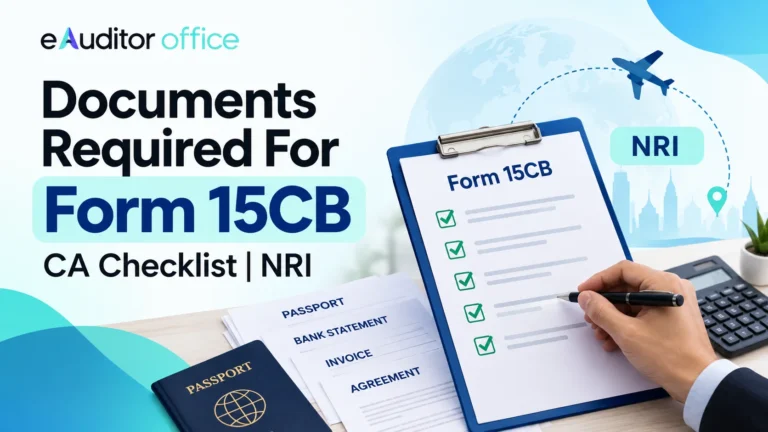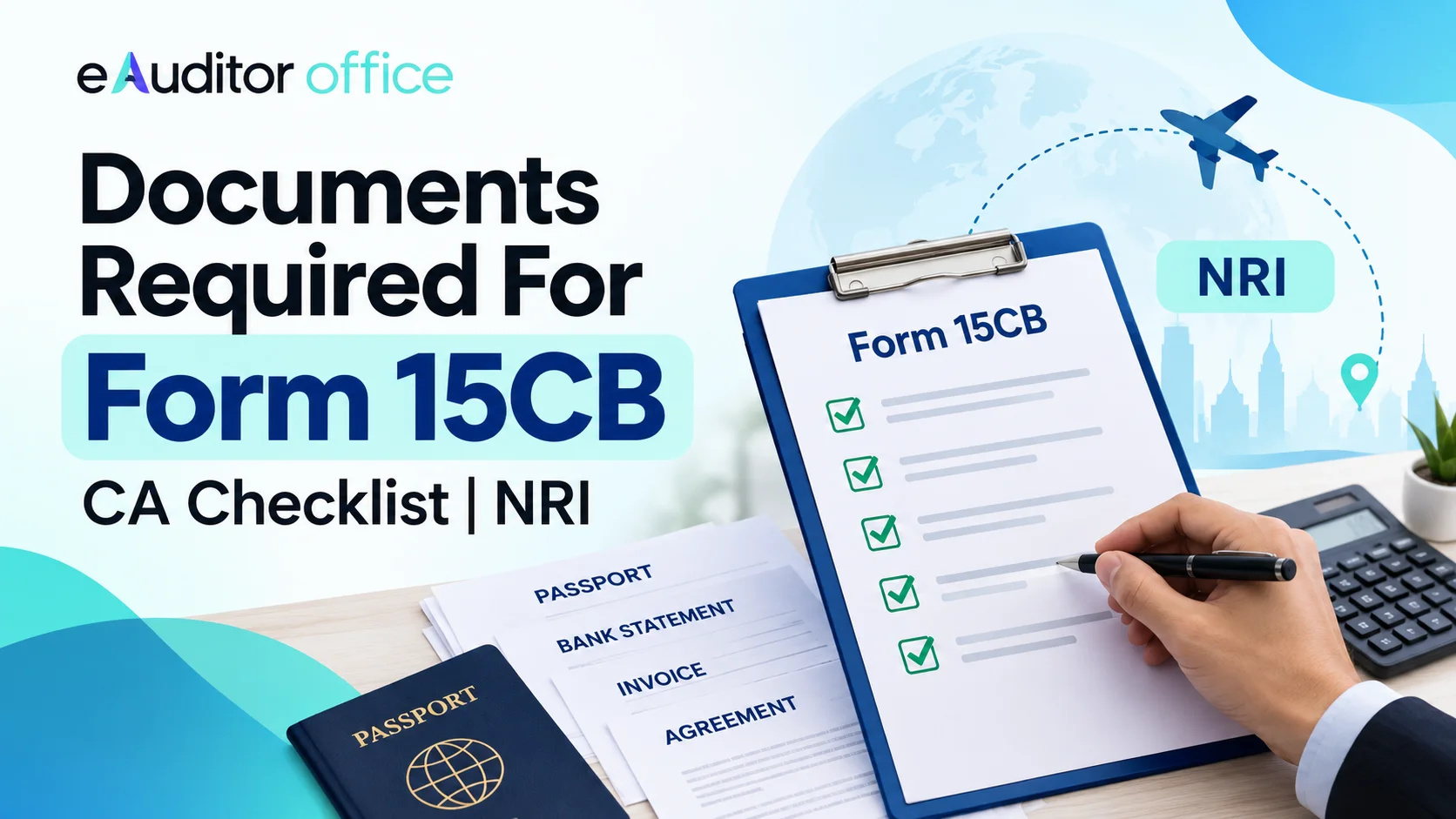
The documents required for Form 15CB usually include the remitter’s PAN and identity details, recipient information, the invoice or agreement, bank instructions, and records supporting the source of funds. Treaty documents and tax deduction records may also be needed, depending on the payment.
There is an important naming change. For remittances made on or after 1 April 2026, the Income Tax Department prescribes Form 146, the equivalent of the earlier Form 15CB. This guide keeps the familiar search term while explaining the documents to prepare for the current certificate process.
Unsure which records apply to your transfer? Contact eAuditor Office about Income Tax / NRI support to review the payment and prepare a transaction-specific document checklist.
What Is Form 15CB, Now Form 146?
It is a Chartered Accountant’s certificate examining the tax treatment of a payment to a non-resident or foreign company. The CA considers the nature of the payment, applicable tax provisions, treaty relief and withholding tax.
Under the current framework, Form 146 supports Part C of Form 145, which replaces Form 15CA. The CA certificate route generally concerns taxable payments where the payment or aggregate exceeds ₹5 lakh during the tax year. Where an applicable Assessing Officer certificate supports Part B, a separate Form 146 is not required.
A transfer exceeding ₹5 lakh does not, by itself, establish that a CA certificate is compulsory. Taxability and the applicable reporting route must be checked first.
Is There One Fixed Document List?
Treat the following as a practical preparation checklist, rather than a universal statutory attachment list. The evidence depends on what is being paid and why.
For example, an overseas consultancy invoice needs different supporting records from the repatriation of property sale proceeds. Your CA may request additional documents after reviewing the transaction.
Documents Required For Form 15CB: A Practical Checklist
1. Remitter Identity And Tax Details
Prepare the sender’s PAN, current address and contact information. An individual should also keep identity and residential-status records ready where relevant.
For a business payment, provide the entity’s legal name and details of the authorised signatory. Share TAN details where applicable to the withholding compliance.
Check that the name used in the bank instruction matches the supporting records. If it differs, explain the reason before the certificate is prepared.
2. Recipient Details
Give the CA the recipient’s full legal name, overseas address, country of tax residence and entity type. Include the recipient’s Indian PAN, if available, and foreign tax identification information where relevant.
Avoid using a brand name when the contract names a different legal entity. If the invoice issuer and bank beneficiary differ, supply an explanation and supporting authority for the payment arrangement.
3. Invoice, Agreement Or Other Payment Evidence
Provide the invoice and the signed agreement, purchase order or engagement letter that explains the transaction.
Useful details include:
- The actual goods, services or rights being paid for.
- The service period and location of performance.
- Payment milestones and currency.
- Whether the agreed amount is inclusive or exclusive of Indian tax.
For advance payments, share the advance request and underlying contract. A final invoice may not yet exist, but the CA still needs evidence of the payment’s purpose.
4. Bank And Remittance Instructions
Prepare the beneficiary’s account details, bank name, country and SWIFT or IBAN information where applicable.
Also provide the proposed remittance date, amount, currency, sending bank and relevant bank instructions. Discuss the RBI purpose code with the bank and CA so it reflects the underlying transaction.
These records help avoid differences between the certificate and the transfer request. They do not replace the bank’s own remittance formalities.
5. Source Of Funds Records
Share records showing where the money came from. Depending on the transaction, these might include bank statements, income ledgers, investment redemption statements or sale documents.
For an NRI transferring accumulated Indian funds, prepare a clear trail from the original receipt to the account being debited. A short reconciliation can help where the balance includes several sources, such as rent, sale proceeds and earlier savings.
Do not assume that an account balance alone explains the tax treatment.
6. Tax Computation And TDS Records
Keep the payment computation, previous related payments and available tax deduction records together. If tax has already been deposited, provide the relevant challan.
Tell the CA whether the overseas recipient must receive a fixed net amount. This affects the calculation where the payer bears the tax.
If tax has not yet been deducted or deposited, explain the transaction’s timing. The CA should determine the applicable obligations rather than work from an assumed payment sequence.
7. Treaty Relief Documents
Where a lower rate or other relief under a Double Taxation Avoidance Agreement is being considered, prepare the recipient’s Tax Residency Certificate covering the relevant period.
The CA may also request the prescribed supplementary tax-residency information, beneficial ownership evidence and a declaration addressing any permanent establishment in India, where relevant.
These documents support the review; they do not automatically establish treaty eligibility. The agreement and actual activities must support the tax position being claimed.
8. Assessing Officer Orders And Earlier Certificates
Share any applicable lower or nil withholding certificate, Assessing Officer order, or earlier advice relating to the same payment.
Include previous remittance certificates where useful for reconciliation. However, a certificate for an earlier transaction does not establish the treatment of a new payment.
Additional Documents For Common NRI Transactions
| Transaction | Supporting Records To Prepare |
| Property Sale Proceeds | Purchase and sale deeds, acquisition-cost records, improvement evidence, capital gains working and available tax records |
| Rental Income | Rental agreement, rent ledger, bank credits and available TDS records |
| Investment Proceeds | Investment statements, purchase details, redemption or sale statements and tax working |
| Inherited Funds | Relevant inheritance documents, estate distribution records and bank trail |
| Earlier Savings | Historical statements and records explaining the original income or receipts |
These are preparation examples. The CA and authorised dealer bank should confirm the requirements for the specific remittance. Tax certification and permission to repatriate funds involve separate checks.
How To Organise Documents Before Sending Them
Create one folder for each transaction. Name files clearly, using descriptions such as “Signed Service Agreement” and “Recipient Bank Details”.
Add a short transaction note explaining who is paying whom, why the payment is due, the amount, currency and proposed transfer date. Mention any missing documents instead of leaving the CA to discover the gap.
For repeated payments, include a schedule of earlier remittances during the year. Share sensitive records through an agreed secure channel.
What Happens After The CA Reviews The Documents?
The CA confirms the applicable certificate route and resolves any gaps in the evidence.
For Form 146, the taxpayer must assign the form to the CA through the e-Filing portal. The CA needs an active portal registration and registered Digital Signature Certificate. The official workflow also includes UDIN validation.
Once filed, retain the certificate, acknowledgement and documents used for the review. Complete the corresponding remittance information filing where required, and follow the bank’s instructions before transferring the funds
Prepare The Records Before Booking The Transfer
Start with the payment evidence and source of funds. Then confirm the current form, tax treatment and bank requirements before fixing a transfer date.
Planning an overseas payment or repatriating Indian income? Speak to eAuditor Office about Income Tax / NRI assistance with your documentation and remittance tax review.
FAQs
No. The need for the current equivalent, Form 146, depends on taxability, the prescribed threshold and the reporting route. Some transactions may qualify for an exception.
Do not decide from the account label alone. Ask the CA to review the source and tax treatment of the funds, and confirm the bank’s documentation requirements.
Prepare it when treaty relief is being considered. Its relevance depends on the tax position being claimed; it is not a substitute for the underlying transaction evidence.
An invoice may not explain the full transaction. The CA may also need the agreement, recipient details, tax records and evidence supporting any treaty claim.
Timing depends on the transaction’s complexity and whether the records are complete. Ask for an estimate after the CA reviews the documents, particularly where treaty questions or capital gains are involved.