Starting a company in India is an exciting milestone — but incorporation is only the first step. Once your company is registered with the Ministry of Corporate Affairs (MCA), you must complete a series of post-incorporation filings and annual compliances to keep it legally active.
Failure to comply with these regulations can lead to penalties, disqualification of directors, and even company strike-off.
This guide covers all the statutory filings, due dates, and practical compliance tips for 2025 — whether you run a Private Limited Company, LLP, or One Person Company (OPC).
1. Key MCA / ROC Compliances
a) Commencement of Business (Form INC-20A)
Timeline: Within 180 days of incorporation.
Attachment: Bank statement showing capital receipt.
Penalty: ₹50,000 on the company and ₹1,000 per day on directors for default.
b) Registered Office Verification (Form INC-22)
If the company’s registered office address was not confirmed during incorporation, you must file Form INC-22 within 30 days of incorporation.
c) Appointment of First Auditor (Form ADT-1)
Timeline: Appoint the first auditor within 30 days of incorporation.
Filing: ADT-1 must be filed within 15 days of appointment.
Validity: Auditor appointed for a period of 5 years.
d) Annual Financial Statements (Form AOC-4 / AOC-4 XBRL)
Purpose: Filing of audited financial statements with ROC.
Due Date:
-
Private Limited / Public Company: Within 30 days of AGM.
-
One Person Company: Within 180 days of financial year-end.
-
e) Annual Return (Form MGT-7 / MGT-7A)
Due Date:
-
Other companies – within 60 days of AGM.
-
OPC – within 60 days after AOC-4 due date (approx. late November).
-
f) Director KYC (DIR-3 KYC / DIR-3 KYC WEB)
Who: Every person holding a Director Identification Number (DIN).
Due Date: 30th September every year (sometimes extended by MCA).
Penalty: ₹5,000 if not filed on time and DIN becomes inactive.
g) Return of Deposits (Form DPT-3)
Purpose: Report all outstanding loans, deposits, or advances.
Due Date: 30th June every year.
Applicability: Mandatory even if no deposits exist (file with “nil” declaration).
h) MSME Payment Disclosure (Form MSME-1)
Purpose: Report payments due to Micro & Small Enterprises exceeding 45 days.
Due Date:
-
April–September half-year: 31st October
-
October–March half-year: 30th April
-
i) Share Capital Reconciliation (Form PAS-6)
Who: All unlisted public companies.
Due Date: Within 60 days of each half-year end (30 May & 29 November).
j) Significant Beneficial Ownership (Form BEN-2)
Purpose: Disclose details of any individual holding significant beneficial ownership (SBO).
k) Charge Creation / Satisfaction (Form CHG-1 / CHG-4)
Purpose: To register any loan or security given to the company.
Timeline:
-
CHG-1 (Creation): Within 30 days.
-
CHG-4 (Satisfaction): Within 30 days after repayment.
-
l) Board Meetings & Annual General Meeting (AGM)
Private/Public Companies:
-
Minimum 4 board meetings a year with not more than 120 days gap.
-
AGM: Annually, latest by 30th September.
-
OPC: AGM not required; however, all resolutions must be recorded and signed by the sole member.
2. Income Tax Compliances
a) TAN & TDS Returns
TAN: Mandatory before deducting any TDS.
TDS Payment: By 7th of next month (for March – by 30th April).
TDS Return Filing: Quarterly returns in Forms 24Q / 26Q / 27Q.
b) Advance Tax
Pay advance tax in four installments:
-
15 June – 15%
-
15 September – 45%
-
15 December – 75%
-
15 March – 100%
-
c) Income Tax Return (ITR-6 / ITR-5 for LLP)
Due Date: 31 October (for companies subject to audit).
Audit Report: To be filed before ITR due date if applicable.
3. GST Compliances
a) GST Registration
Obtain GSTIN if your turnover exceeds ₹40 lakh (₹20 lakh for services) or if you are involved in interstate supply.
b) GST Monthly/Quarterly Returns
GSTR-1: Monthly/quarterly outward supply return.
GSTR-3B: Summary return with tax payment.
Due Dates: Vary by state and turnover (usually 11th & 20th of each month).
c) Annual GST Return (GSTR-9 / 9C)
Due Date: 31 December following the end of financial year.
Applicability: Mandatory for turnover above threshold limit.
4. Labour Law & State Registrations
After incorporation, depending on employee strength and location, register for:
EPF (Provident Fund) – applicable when employee count ≥ 20.
ESI (Employee State Insurance) – applicable when count ≥ 10.
Professional Tax – state-wise registration and monthly/quarterly payment.
Shops & Establishments Act – compulsory registration for every office.
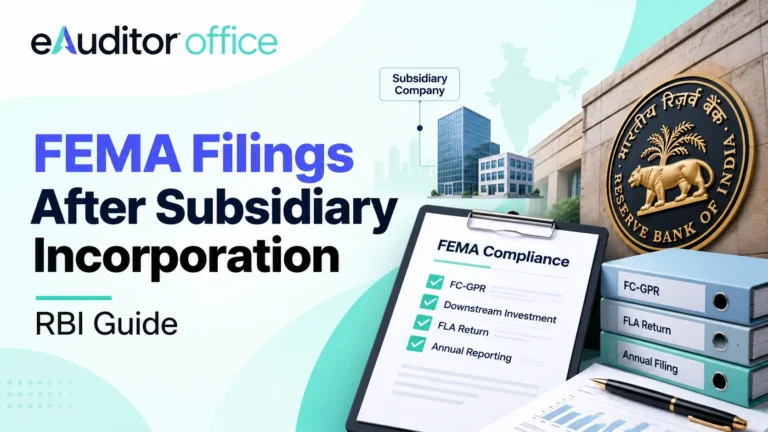
5. FEMA / RBI Compliances (if applicable)
If your company receives foreign investment:
Annual FLA Return: File by 15 July every year if foreign assets/liabilities exist.
6. Important Due Dates Summary
| Compliance | Form | Due Date | Frequency |
|---|---|---|---|
| Commencement of Business | INC-20A | Within 180 days | One-time |
| Appointment of Auditor | ADT-1 | Within 15 days | Annual |
| Financial Statement | AOC-4 | 30 days of AGM / 180 days (OPC) | Annual |
| Annual Return | MGT-7 / 7A | 60 days of AGM | Annual |
| Director KYC | DIR-3 KYC | 30 September | Annual |
| Deposit Return | DPT-3 | 30 June | Annual |
| MSME Payment | MSME-1 | 30 Apr / 31 Oct | Half-yearly |
| TDS Return | 24Q / 26Q | 31 Jul / 31 Oct / 31 Jan / 31 May | Quarterly |
| GST Return | GSTR-1 / 3B | Monthly / Quarterly | Regular |
| FLA Return | 15 July | Annual |
7. Common Mistakes Startups Make
Missing INC-20A deadline: MCA can deactivate your company for non-filing.
Not appointing an auditor: Results in non-compliance with Section 139.
Ignoring DIR-3 KYC: Deactivates your DIN.
Skipping DPT-3 or MSME-1: Attracts heavy late fees even for “nil” filings.
Forgetting to maintain registers: All companies must keep statutory registers at their registered office.
Late GST filings: Causes blocking of e-way bills and ITC mismatch.
8. Compliance Checklist for New Companies
Immediately after incorporation:
Open current account and collect capital proof.
File INC-20A within 180 days.
Appoint auditor and record in board minutes.
Apply for GST, Professional Tax, and Shops & Establishments registration.
Maintain statutory registers and minutes book.
Every quarter:
Deposit and file TDS returns.
File GST returns as applicable.
Every half-year:
File MSME-1 (if applicable).
Annually:
File AOC-4, MGT-7/7A, DPT-3, DIR-3 KYC, ITR, FLA (if applicable).
9. Why Compliance Matters
Staying compliant is not just about avoiding penalties — it:
Builds trust with banks, investors, and regulators.
Simplifies future due diligence and fundraising.
Helps maintain good corporate governance.
Protects directors from legal liabilities.
10. Conclusion
Every business registered under the Companies Act must fulfill post-incorporation and annual compliance obligations. The best approach is to plan your compliance calendar in advance and engage professionals to ensure accuracy and timely filings.
At eAuditor Office, we assist startups, SMEs, and growing companies with end-to-end compliance management — from incorporation to annual filings and tax registrations — ensuring your business stays compliant and worry-free.
An OPC must file: AOC-4 (Financial Statement) within 180 days from year-end. MGT-7A (Annual Return) within 60 days after AOC-4 due date. DIR-3 KYC, DPT-3, and ITR annually. There’s no need for an AGM, but all resolutions must be recorded in writing.
No. GST registration is required only if: Your annual turnover exceeds ₹40 lakh (goods) or ₹20 lakh (services), or You make interstate supplies or sell through e-commerce platforms. Even if not mandatory, many companies voluntarily register to claim input tax credit (ITC) and enhance credibility.