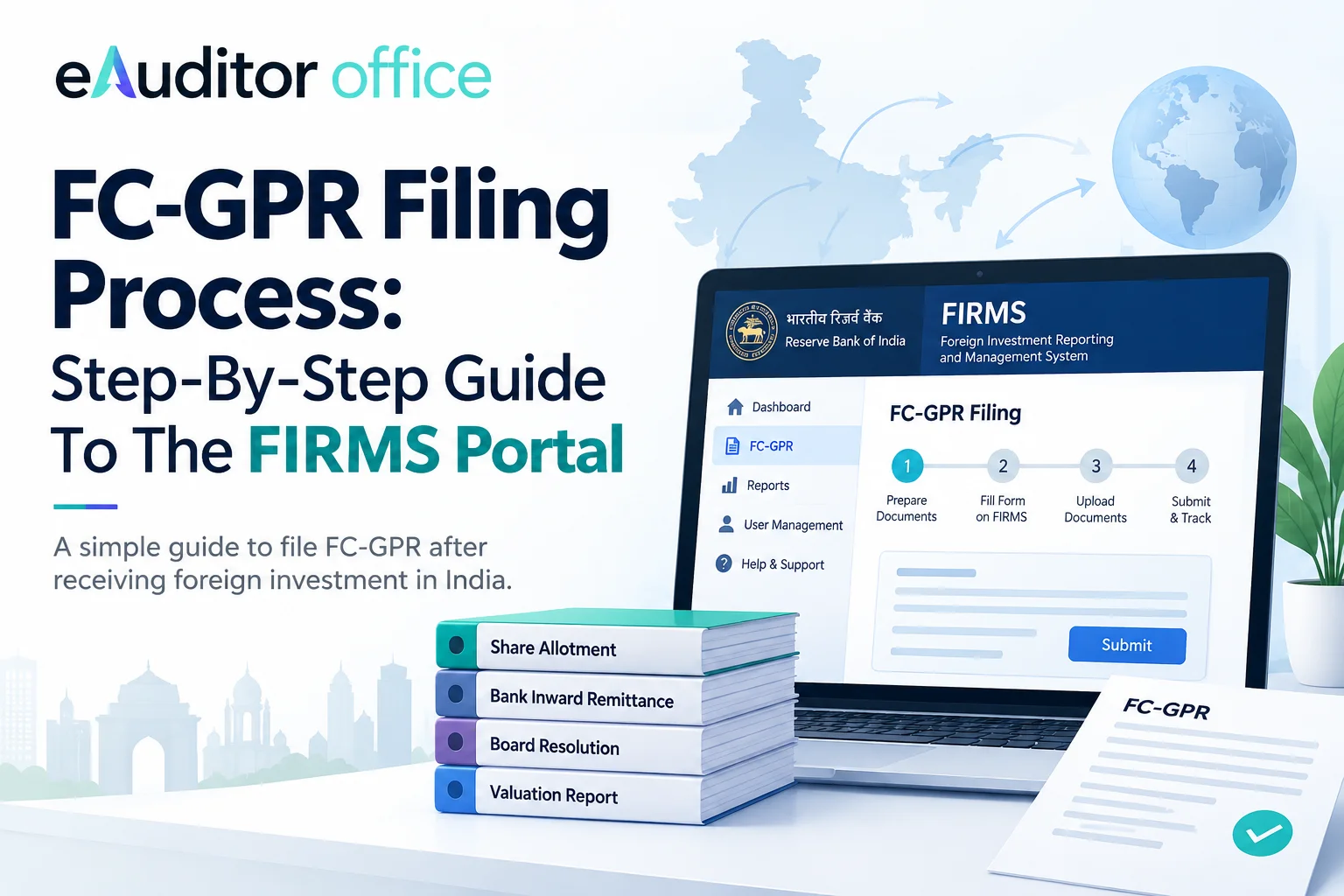
When an Indian company issues equity instruments to a person resident outside India, it must report the issue through Form FC-GPR on the Reserve Bank of India’s FIRMS portal.
The filing can be returned when the Entity Master, investor details, valuation documents or shareholding pattern do not match. This guide explains the FC-GPR filing process in the order a company will usually follow it, from checking the transaction to completing the Authorised Dealer bank review.
What Is Form FC-GPR?
Form FC-GPR, or Foreign Currency-Gross Provisional Return, is the prescribed report for an Indian company that issues eligible equity instruments to a person resident outside India.
It is filed through the Single Master Form (SMF) on RBI’s Foreign Investment Reporting and Management System (FIRMS) portal. The form is routed to the company’s designated Authorised Dealer Category-I bank for verification.
FC-GPR may cover equity shares, compulsorily convertible preference shares, compulsorily convertible debentures and other eligible equity instruments. It can also apply to certain bonus issues, rights issues, employee stock options, sweat equity, cross-border mergers and conversion of convertible notes. The transaction must be classified correctly before filing.
Need help with FC-GPR filing after incorporating your foreign subsidiary? E-Auditor Office can assist with FIRMS portal filing, documentation and FEMA compliance to help you complete the process accurately and on time.
Who Must File FC-GPR And By When?
The Indian company issuing the instruments is responsible for filing. Form FC-GPR must generally be submitted within 30 days from the date of issue or allotment. The deadline runs from the issue date, not simply the date on which the money reached the company’s bank account.
An LLP does not use FC-GPR to report a foreign capital contribution. A transfer of existing shares between a resident and non-resident is also generally reported through Form FC-TRS, not FC-GPR.
Checks To Complete Before Filing
Before opening the SMF, confirm that:
- The investor and business activity are eligible under the applicable FDI rules.
- The investment is within the sectoral cap and uses the correct entry route.
- Government approval is available if the approval route applies.
- The issue price follows the applicable pricing guidelines.
- The money came through a permitted mode and remitter KYC is available.
- Corporate approvals, allotment and Companies Act filings are complete.
FC-GPR is a reporting form. Filing it does not correct a defect in the investment, pricing or allotment.
Setting up an Indian company with a foreign parent involves more than incorporation. E-Auditor Office can assist with Foreign Subsidiary Incorporation, documentation and the post-incorporation compliances connected with foreign investment.
Documents Required For FC-GPR Filing
The list depends on the transaction and the AD bank. Common documents include:
- FIRC, bank advice or other evidence of receipt of funds
- KYC report for the foreign investor or remitter
- Board resolution approving the allotment
- List of allottees and details of the instruments issued
- Valuation certificate or report, where required
- Company Secretary certificate confirming applicable compliance
- Government or regulatory approval, where applicable
- Transaction-specific declarations, agreements or clarification letters
Names, dates, issue price, instrument count and amounts must be consistent across the form and attachments.
FC-GPR Filing Process On The FIRMS Portal
Step 1: Check The Entity Master
Confirm that the company’s name, CIN, registered office, sector, capital and existing foreign investment details are correct in the Entity Master. SMF uses this information to populate parts of the return. Correct inaccurate opening data before preparing FC-GPR.
Step 2: Register The Business User
The authorised filer must register as a Business User on FIRMS. Registration generally requires company details, the user’s information, an authorisation letter and the chosen AD bank branch. The AD bank verifies the request before portal access is approved.
Choose the bank and branch carefully because the form will be routed there for review.
Step 3: Select FC-GPR In The Single Master Form
Log in, open the Single Master Form and select FC-GPR as the return type. Create a fresh return for the relevant allotment. If it is saved as a draft, retain the reference details.
Step 4: Enter The Common Details
Review the entity information and select the entry route, sector and sectoral cap. These entries must reflect the company’s activity and the foreign investment rules applicable to the transaction.
Do not select the automatic route merely because filing takes place online. The entry route describes how the investment is permitted.
Step 5: Complete The Issue Details
Enter the issue date, instrument type, number of instruments and nature of issue. The portal may ask whether it is a cash issue, rights issue, bonus issue, conversion, merger, employee benefit or another permitted category.
Use the board and allotment records as the source. The issue date entered here is central to the 30-day deadline.
Step 6: Add The Foreign Investor Details
Enter the investor’s legal name, country, address and constitution. The details should match the KYC report and investment records. If the remitter and beneficial owner differ, the bank may require additional KYC, explanations, agreements and a no-objection letter.
Step 7: Report The Inflow And Issue Amount
Enter the amount received, currency, receipt date and banking reference, then map the inflow to the instruments issued. The rupee amount, issue price, instrument count and total consideration must reconcile.
Where several remittances fund one allotment, capture each relevant receipt. Resolve rounding or mapping differences before submission.
Step 8: Enter Valuation Details
State the fair value and issue price, and upload the valuation document where required. The valuation date, method, professional eligibility and figures should support the price reported.
Pricing rules differ based on the company and transaction. Do not reuse an old valuation report without checking its relevance.
Step 9: Verify The Shareholding Pattern
Review the pre-transaction and post-transaction holdings, paid-up capital and resident/non-resident ownership. If the pre-transaction data is wrong, check the Entity Master and earlier filings rather than forcing the current transaction to fit incorrect figures.
Step 10: Upload And Submit
Upload signed, clear and legible attachments in the accepted format. Review every tab, submit the form and save the acknowledgement and reference number.
Submission is not final approval. The designated AD bank must still verify the return.
Planning a Foreign Subsidiary Incorporation in India? E-Auditor Office can help with incorporation and the connected FEMA and foreign investment reporting requirements, from initial documentation through post-incorporation compliance.
What Happens After Submission?
The AD bank reviews the form, KYC, pricing, entry route, sectoral cap and supporting documents. It may approve the filing or return it for clarification.
If it is returned, answer every remark with corrected documents or a clear explanation. Avoid changing unrelated fields. Track the form until approval and retain the final acknowledgement with the company’s FEMA records.
Common FC-GPR Filing Errors
Common errors include outdated Entity Master data, selection of the wrong AD bank branch, mismatched investor names, an incorrect issue date, inconsistent remittance figures, unsupported valuation, the wrong sectoral cap and a shareholding pattern that does not reconcile.
Companies also lose time when they wait until the end of the 30-day period to request KYC or valuation documents. Preparing the reporting file alongside the allotment helps prevent this.
What If FC-GPR Is Filed Late?
A delayed report may attract a Late Submission Fee under the RBI framework. Paying it addresses the reporting delay only to the extent permitted by the applicable rules. It does not automatically cure a breach involving eligibility, entry route, pricing, sectoral limits or the underlying transaction.
If the matter goes beyond a reporting delay, obtain advice on the appropriate FEMA regularisation or compounding route.
Conclusion
The FC-GPR filing process is easier when it forms part of the investment and allotment workflow. Correct Entity Master data, consistent documents and early coordination with the AD bank prevent most avoidable delays.
FAQs
The company files FC-GPR online through FIRMS. The form is routed to its designated AD Category-I bank for verification under RBI’s reporting system.
FC-GPR must generally be filed within 30 days from the date on which the equity instruments are issued or allotted to the person resident outside India.
If the AD bank returns the form, the company can correct the points raised and resubmit it. For a change to an approved form, the company should approach its AD bank and follow the process permitted on FIRMS.
It is generally required when the Indian subsidiary issues eligible equity instruments to its foreign parent or another non-resident investor. The exact treatment depends on the instrument and transaction.