Choosing between an LLP and a private limited company affects much more than your registration certificate. It changes how the business is taxed, how owners withdraw profits, which annual filings must be completed, how easily investors can enter, and what happens when the business cannot pay its debts.
For many professional firms and closely held businesses, an LLP is attractive because its internal structure is flexible and its routine compliance is generally lighter. A private limited company is usually a better fit for a startup planning to issue equity, raise venture capital, offer employee stock options, or prepare for a future acquisition.
There is no universal winner in the LLP vs private limited company comparison. The right structure depends on how your business plans to earn, distribute, and raise money.
Quick Answer: Choose an LLP if you want operational flexibility, limited liability, and relatively lighter compliance without immediate equity fundraising plans. Choose a private limited company if you expect external investors, ESOPs, multiple share classes, or frequent ownership changes.
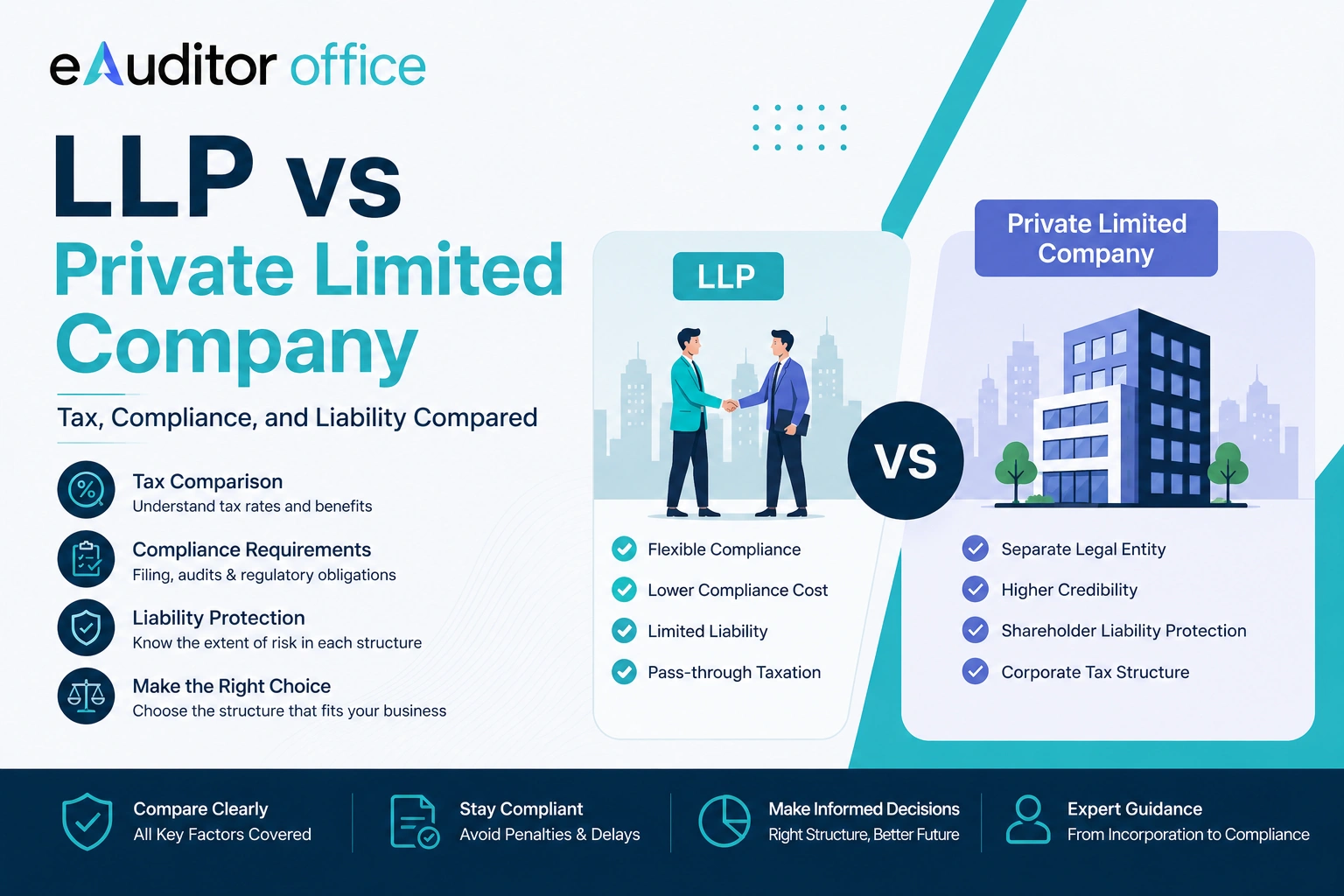
LLP vs Private Limited Company At A Glance
| Factor | LLP | Private Limited Company |
| Governing law | Limited Liability Partnership Act, 2008 | Companies Act, 2013 |
| Owners | Partners | Shareholders or members |
| Management | Partners and designated partners | Board of directors |
| Minimum participants | Two partners and two designated partners | Two members and two directors |
| Separate legal entity | Yes | Yes |
| Liability | Generally limited to the agreed contribution | Generally limited to unpaid share capital |
| Income-tax rate | 30%, plus applicable surcharge and cess | Depends on the applicable tax regime |
| Profit withdrawal | Share of profit is generally exempt in the partners’ hands | Dividends are generally taxable in shareholders’ hands |
| Statutory audit | Exemption may be available below prescribed limits | Mandatory every year |
| Equity fundraising | Limited because an LLP cannot issue shares | Suitable for equity investment and ESOPs |
| Compliance burden | Usually lower | Usually higher |
| Best suited for | Professional firms, agencies and closely held businesses | Startups and companies seeking investment |
What Is An LLP?
A Limited Liability Partnership, or LLP, is a separate legal entity registered under the Limited Liability Partnership Act, 2008. It combines the flexibility of a traditional partnership with limited liability protection.
The partners decide their rights, responsibilities, profit-sharing ratio, voting powers, management structure, and exit conditions through an LLP agreement.
An LLP must have at least two partners and two designated partners. At least one designated partner must meet the applicable Indian residency requirement.
An LLP can own assets, enter into contracts, borrow money, and continue operating even when its partners change.
What Is A Private Limited Company?
A private limited company is a separate legal entity incorporated under the Companies Act, 2013. Its ownership is divided into shares, while its board of directors manages the business.
A private company requires at least two members and two directors. Its Articles of Association restrict the transfer of shares, limit the number of members to 200, and prevent the company from inviting the public to subscribe to its securities.
The share-based ownership structure makes a private limited company easier for angel investors, venture capital firms, and corporate buyers to understand and invest in.
Unsure whether a Limited Liability Company or private limited company is right for your business? Consult eAuditor Office for professional entity-selection and business-registration guidance in India.
LLP vs Private Limited Company: Tax Comparison
Tax is often treated as the deciding factor when choosing between an LLP and a private limited company. However, comparing only the headline tax rates can give an incomplete picture.
Business owners must also consider deductions, partner remuneration, dividends, profit withdrawals, surcharge, cess, and the way money will eventually reach the owners.
Income Tax On An LLP
For Assessment Year 2026–27, a partnership firm, including an LLP, is taxed at 30%.
A surcharge of 12% applies when taxable income exceeds ₹1 crore. Health and Education Cess is charged at 4% on the income tax and applicable surcharge.
An LLP may also be subject to Alternate Minimum Tax when the relevant provisions apply. AMT is calculated on adjusted total income rather than regular taxable income.
One practical tax advantage of an LLP is that the partners’ share of profit is generally exempt in their hands after the LLP pays tax.
Interest and remuneration paid to partners are treated differently. These payments must satisfy the relevant tax provisions and be authorised by the LLP agreement to qualify as deductible business expenses.
Income Tax On A Private Limited Company
A domestic private limited company does not have one fixed tax rate for every situation.
For Assessment Year 2026–27, the main corporate tax rates include:
- 25% where the prescribed turnover conditions are satisfied
- 22% under Section 115BAA, subject to specified conditions
- 15% under Section 115BAB for eligible new domestic manufacturing companies
- 30% for other domestic companies
A company opting for Section 115BAA pays a 10% surcharge and 4% Health and Education Cess. This results in an effective tax rate of approximately 25.17%.
However, a company choosing this regime must give up certain deductions and tax incentives. The decision should be reviewed carefully because the 22% tax rate is not automatically available without conditions.
When the company distributes its post-tax profits as dividends, shareholders generally pay tax on the dividend income at their applicable rates.
This creates an additional consideration that is not normally present in an LLP, where the partners’ share of taxed profit is generally exempt in their hands.
Which Structure Is More Tax-Efficient?
The answer depends on what happens to the profits.
If most of the earnings will remain in the business to fund growth, a private limited company eligible for the 22% tax regime may have a lower entity-level tax rate than an LLP.
If the owners plan to withdraw most of the profits regularly, the tax payable on dividends can reduce or remove that advantage.
An LLP may be more suitable for owners who want to share and withdraw profits without a separate dividend tax layer.
A private limited company may still work better when the founders plan to reinvest profits, pay commercially reasonable salaries, build equity value, and raise external capital.
Do not choose your business structure based only on the 30% versus 22% comparison. A projected tax calculation covering both the business and its owners will provide a clearer answer.
LLP vs Private Limited Company: Compliance Requirements
Both LLPs and private limited companies must maintain financial records, file income-tax returns, and complete event-based filings.
The main difference is the number of corporate procedures and annual filings involved.
Annual Compliance For An LLP
An LLP generally needs to file:
- Form 11 as its annual return
- Form 8 as its statement of account and solvency
- Annual income-tax returns
- Filings for changes in contribution
- Filings for changes to the registered office
- Filings for amendments to the LLP agreement
An audit under the LLP Rules may not be required where annual turnover does not exceed ₹40 lakh and partner contribution does not exceed ₹25 lakh.
However, a tax audit may still be required under income-tax law depending on the LLP’s turnover, receipts, business activities, and other conditions.
Even a small or inactive LLP must complete the filings applicable to it. LLP registration does not mean that the business has no annual compliance responsibilities.
Annual Compliance For A Private Limited Company
A private limited company generally has a wider annual compliance calendar.
Its compliance requirements may include:
- Maintaining statutory registers and accounting records
- Conducting board meetings
- Conducting an Annual General Meeting
- Completing a statutory audit every financial year
- Filing financial statements with the Registrar of Companies
- Filing the company’s annual return
- Filing the annual income-tax return
- Maintaining board resolutions and meeting minutes
The exact requirements depend on the company’s size, transactions, shareholding structure, and business activities.
Which Has Lower Compliance Costs?
An LLP generally costs less to maintain because it has fewer corporate formalities. It may also qualify for exemption from statutory audit when it remains below the prescribed turnover and contribution limits.
A private limited company normally costs more to maintain because statutory audit and Companies Act compliance apply even when the company has limited business activity.
The lower compliance cost of an LLP can be valuable for a consulting practice, professional firm, agency, or family-run business.
For a funded startup, however, the governance and reporting requirements of a private limited company are often necessary for investors and future growth.
LLP vs Private Limited Company: Liability Protection
Both an LLP and a private limited company provide a separate legal identity and limited liability protection.
However, limited liability is not absolute under either structure.
Liability Of LLP Partners
An LLP partner is generally not personally responsible for the LLP’s obligations only because they are a partner. Their liability is normally limited to their agreed contribution.
However, a partner may be personally liable for their own wrongful act or omission.
If an LLP or its partners act with the intention of defrauding creditors or conduct business for a fraudulent purpose, the partners involved may face unlimited liability.
Liability Of Company Shareholders And Directors
A shareholder’s liability is generally limited to the unpaid amount on their shares.
Directors are not automatically responsible for every company debt. However, they may face personal liability for:
- Fraud or misrepresentation
- Breach of statutory duties
- Personal wrongdoing
- Non-compliance with specific legal requirements
- Liabilities covered by personal guarantees
Banks, landlords, and financial institutions may ask founders or directors to provide personal guarantees.
Once a personal guarantee is signed, the private limited company structure does not protect the guarantor from that contractual obligation.
Does Limited Liability Protect Personal Assets Completely?
No. Limited liability protects owners from ordinary business obligations of the entity.
It does not protect them from personal guarantees, fraud, statutory liabilities, or responsibility for their own misconduct.
Ownership, Funding, And Growth
The biggest difference between an LLP and a private limited company becomes visible when the business wants to raise capital or change its ownership structure.
Fundraising Through An LLP
An LLP can admit new partners and change its contribution or profit-sharing arrangements through the LLP agreement.
However, an LLP cannot issue equity shares in the same way as a private limited company.
This makes an LLP less convenient for:
- Venture capital investments
- Angel funding
- Employee Stock Option Plans
- Convertible securities
- Structured investor exits
An LLP can still raise debt or receive additional partner contributions, but its fundraising options are more limited.
Fundraising Through A Private Limited Company
A private limited company can issue and transfer shares, subject to the Companies Act, its Articles of Association, and relevant shareholder agreements.
It can also create different classes of securities and introduce an Employee Stock Option Plan after meeting the applicable legal requirements.
For founders expecting several funding rounds, a private limited company is generally the more practical choice.
Investors can measure ownership through shareholding, negotiate specific investor rights, and plan their exit through a share transfer or acquisition.
Management And Decision-Making
An LLP is managed mainly according to its LLP agreement.
The partners can decide:
- Who will manage the business
- How voting rights will work
- How profits will be divided
- Which decisions require partner approval
- How new partners will be admitted
- What happens when a partner leaves
This flexibility makes an LLP suitable for a small group of active owners.
A private limited company follows a more formal separation between ownership and management.
Shareholders own the company, while directors manage its day-to-day and board-level affairs. Certain decisions require shareholder approval, board resolutions, prescribed notices, and Registrar of Companies filings.
This structure can be useful when founders, employees, and investors have different roles in the business.
Transfer, Exit, And Business Continuity
Both an LLP and a private limited company have perpetual succession. The entity can continue operating even when a partner, shareholder, or director changes.
In an LLP, the transfer of economic and management rights depends heavily on the LLP agreement. A partner’s exit may require consent from other partners, amendments to the agreement, and regulatory filings.
In a private limited company, shares can be transferred subject to the Articles of Association, shareholder agreements, and Companies Act requirements.
A share-based ownership structure usually provides a more familiar route for investor exits, acquisitions, and succession planning.
When Should You Choose An LLP?
An LLP may be suitable when:
- The owners will actively manage the business
- External equity funding is not expected
- The partners want flexible profit-sharing arrangements
- Lower routine compliance is a priority
- The owners prefer a partnership-style management structure
- Profits will be regularly distributed among the partners
LLPs are commonly suitable for consulting businesses, agencies, professional firms, closely held businesses, and certain joint ventures.
Professional eligibility rules should be checked separately when the business operates in a regulated industry.
When Should You Choose A Private Limited Company?
A private limited company may be suitable when:
- The business plans to raise angel or venture capital
- The founders want to offer ESOPs
- Profits will be reinvested for future growth
- Enterprise customers prefer dealing with a company
- The founders are planning for a future acquisition or investor exit
A private limited company is generally the stronger option for a startup built around scalable technology, external investment, and long-term equity value.
LLP Or Private Limited Company: Decision Checklist
Before registering your business, answer the following questions:
- Will the business seek equity investment within the next three to five years?
- Will most profits be reinvested or withdrawn by the owners?
- Are ESOPs part of the hiring plan?
- How much annual compliance cost can the business support?
- Do the owners need flexible profit-sharing arrangements?
- Will banks, overseas clients, or enterprise customers prefer a company?
If equity investment, ESOPs, or a future share sale are priorities, a private limited company usually has the advantage.
If flexibility, lower routine compliance, and regular profit distribution matter more, an LLP may be the better choice.
Final Verdict: LLP vs Private Limited Company
An LLP provides flexible management, partnership-style profit distribution, limited liability, and a generally lighter compliance burden. It works well when a small group of owners will operate the business without seeking institutional equity investment.
A private limited company requires more documentation and annual compliance, but it is designed for share-based ownership, investors, ESOPs, and structured growth.
The best decision should be based on the next three to five years of the business, not only the initial registration cost.
Compare your expected profits, owner withdrawals, investment plans, customer requirements, compliance budget, and preferred exit route before choosing between an LLP and a private limited company.
FAQs
An LLP is often better for a closely held professional or service business that does not plan to raise equity.
A private limited company is usually better for startups seeking investment, ESOPs, and scalable ownership.
An LLP is taxed at 30% for AY 2026–27, while an eligible domestic company may choose the 22% Section 115BAA regime, subject to conditions.
However, shareholders may also pay tax when dividends are distributed. Therefore, a lower corporate tax rate does not automatically mean a lower overall tax cost.
Conversion may be possible through the applicable legal process. However, it requires planning around assets, contracts, taxation, registrations, and regulatory approvals.
A business expecting equity funding should consider incorporating as a private limited company from the beginning instead of depending on a future conversion.
Yes. A private limited company must complete a statutory audit every financial year, regardless of its turnover or business activity.
An LLP may be exempt from audit under the LLP Rules when its turnover does not exceed ₹40 lakh and its contribution does not exceed ₹25 lakh.
A separate tax audit may still be required under income-tax law.