Getting the Certificate of Incorporation feels like the finish line. It isn’t. It’s the starting gun for a set of compliances that the Ministry of Corporate Affairs expects you to complete on a fixed clock, and it doesn’t send reminders. Miss the window on something as basic as appointing an auditor, and you’re already looking at a penalty before your company has issued its first invoice.
This is the post-incorporation compliance checklist we walk every new Pvt Ltd client through at eAuditorOffice — what’s due, by when, and what it actually costs to get it wrong. Bookmark it, or better, hand the whole list to someone who’ll track the dates for you.
Ready to make your business official? Get your Private Limited Company registered with expert assistance.
Why the first 180 days matter more than founders expect
Most founders budget time and attention for the incorporation process itself — the SPICe+ form, the name approval, the MOA and AOA — and then quietly assume the hard part is over. It isn’t. The Companies Act, 2013 treats a private limited company as fully accountable from the date on the certificate, whether or not you’ve opened a bank account yet.
Three things make this stretch riskier than it looks. First, several deadlines are short: 30 days for the first board meeting, 30 days for the auditor appointment, 60 days for share certificates. Second, the penalties are personal as well as corporate — directors can be fined per day of delay, not just the company. Third, a lapsed filing here doesn’t stay contained. It shows up later, during a bank account opening, a funding round’s due diligence, or a tender application, at exactly the moment you have the least room to fix it.
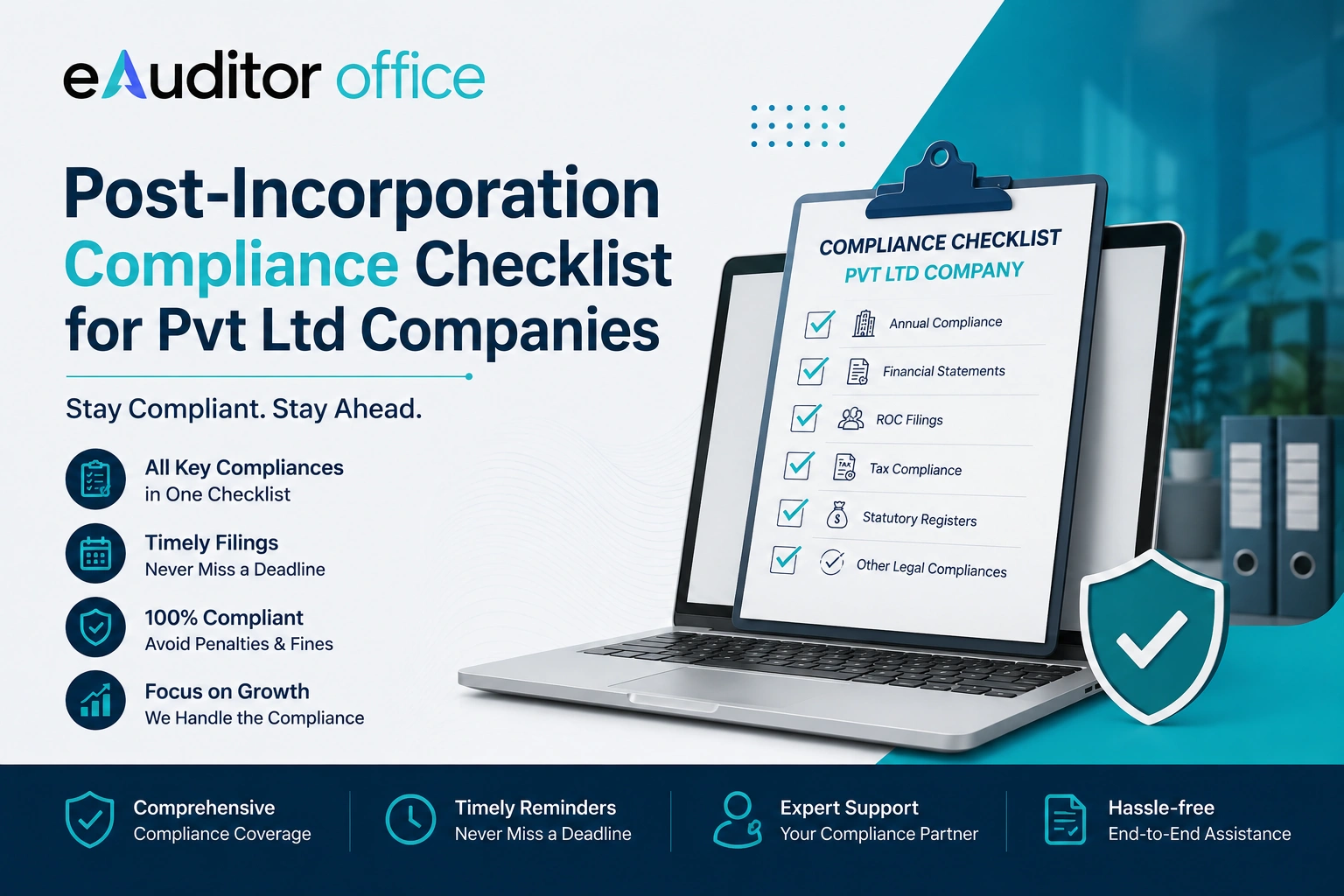
The post-incorporation compliance checklist, in order
These are listed roughly in the sequence you’ll hit them, not by importance — they’re all mandatory.
1. Open a company bank account
Route every transaction through a current account in the company’s name, not a founder’s personal account. Banks will ask for the Certificate of Incorporation, PAN, board resolution authorising the account, and KYC documents for the authorised signatories. Do this early — nearly every downstream step, from share subscription money to vendor payments, needs a company account behind it.
2. Hold the first board meeting — within 30 days
The Companies Act requires the first board meeting within 30 days of incorporation. On the agenda: appointing the statutory auditor, noting the registered office, approving the common seal (if used), and authorising bank account opening. Minute it properly — this document gets referenced constantly in later compliance and audit work.
3. Appoint your statutory auditor — Form ADT-1
Every Pvt Ltd company needs a statutory auditor, appointed by the board within 30 days of incorporation, and confirmed by filing Form ADT-1 with the Registrar of Companies. Skip this and the company can’t legally have its books audited, which then blocks nearly every filing that comes after it.
4. File MBP-1 and DIR-8 at that first meeting
Each director should submit Form MBP-1 (disclosure of interest in other entities) and DIR-8 (a declaration of non-disqualification) at the first board meeting, and again at the start of every financial year. It’s a five-minute form. Forgetting it isn’t a five-minute fix once an auditor flags it later.
5. Issue share certificates — within 60 days
Subscribers to the memorandum need their share certificates within 60 days of incorporation. This isn’t paperwork for its own sake — it’s the legal proof of who owns what, and it’s one of the first things investors, lenders, or a due diligence team will ask to see.
6. File INC-20A — declaration of commencement of business, within 180 days
This is the one that trips people up most, because 180 days feels like a long runway until it suddenly isn’t. Form INC-20A confirms the company has received its subscription money and is ready to commence business. Miss it, and the penalty is steep: ₹50,000 for the company and ₹1,000 per day for every director in default, on top of the risk of the Registrar striking the company off the register.
7. Maintain statutory registers
Registers of members, directors, share transfers, and charges need to be maintained from day one and kept available for inspection — this isn’t a once-off filing, it’s a standing obligation. Most companies keep these digitally now, which makes audits considerably less painful.
8. Register for GST, and PF or ESI where they apply
GST registration is mandatory once turnover crosses the threshold for your state and business type, or immediately if you’re selling across state lines or through e-commerce. Provident Fund and ESI registration kick in once employee headcount crosses their respective thresholds — worth checking early if you’re hiring fast.
9. File DPT-3 — deposit and loan disclosures, by 30 June each year
If the company has taken director loans, founder advances, or any receipt that could be classified as a deposit, it needs disclosure in Form DPT-3, due by 30 June every year. Founder loans are a common blind spot here — many early-stage companies have them and don’t realise they need disclosing even though they’re not public deposits.
10. Stay ready for the annual cycle — AOC-4, MGT-7 or MGT-7A, ITR-6
Once the first financial year closes, the annual compliance clock starts: audited financials and the board’s report in Form AOC-4 within 30 days of the AGM, the annual return in Form MGT-7 (or MGT-7A for small companies) within 60 days of the AGM, and the income tax return in ITR-6, due 31 October if a tax audit applies, or 31 July otherwise.
Talk to eAuditorOffice about post-incorporation compliance: eauditoroffice.com
Quick-reference: deadlines and penalties
| Compliance | Form / action | Deadline | Penalty for delay |
|---|---|---|---|
| Bank account | Open in company’s name | Before first transaction | No banking channel for funds received |
| First board meeting | Minutes + MBP-1, DIR-8 | Within 30 days | Officer-in-default penalty under the Companies Act |
| Auditor appointment | Form ADT-1 | Within 30 days | Late filing fee, scales with delay |
| Share certificates | Issued to subscribers | Within 60 days | ₹25,000–₹5,00,000 range under Section 56 |
| Commencement of business | Form INC-20A | Within 180 days | ₹50,000 (company) + ₹1,000/day (each director) |
| Deposit/loan disclosure | Form DPT-3 | 30 June, annually | Up to ₹10 crore or twice the deposit, whichever is lower |
What actually happens if you miss a deadline
It rarely ends at the fine, though the fine alone can be uncomfortable for a company that’s a few months old. A lapsed INC-20A or DPT-3 filing gets flagged the moment you apply for a business loan, bring on an investor, or respond to a government tender — and by then you’re fixing it under time pressure instead of on your own schedule. Directors who accumulate defaults across their filings can lose the ability to sign documents for any company they’re associated with, not just this one. None of it is catastrophic on its own. All of it is avoidable with a calendar and someone checking it.
FAQs
It’s the set of statutory steps a private limited company must complete after receiving its Certificate of Incorporation — including the first board meeting, auditor appointment, share certificate issuance, and the INC-20A commencement-of-business filing — each with its own deadline under the Companies Act, 2013.
180 days from the date of incorporation. Missing it triggers a ₹50,000 penalty for the company and ₹1,000 per day for each director in default, and can eventually lead to the Registrar striking the company off.
Not for most small and mid-sized Pvt Ltd companies — a Company Secretary becomes mandatory only above certain paid-up capital or turnover thresholds. That said, engaging a CS or a CA voluntarily from day one is standard practice, since the filings are frequent and the penalties are personal to directors.
There’s no separate standalone penalty line for a late first board meeting, but it cascades — the auditor appointment, MBP-1, and DIR-8 filings that happen at that meeting all slip too, and each of those does carry its own penalty for delay.
Most of them do, including auditor appointment, INC-20A, and statutory registers. A few requirements are relaxed for OPCs — annual return filing uses MGT-7A instead of MGT-7, for instance — but the core post-incorporation timeline is largely the same.