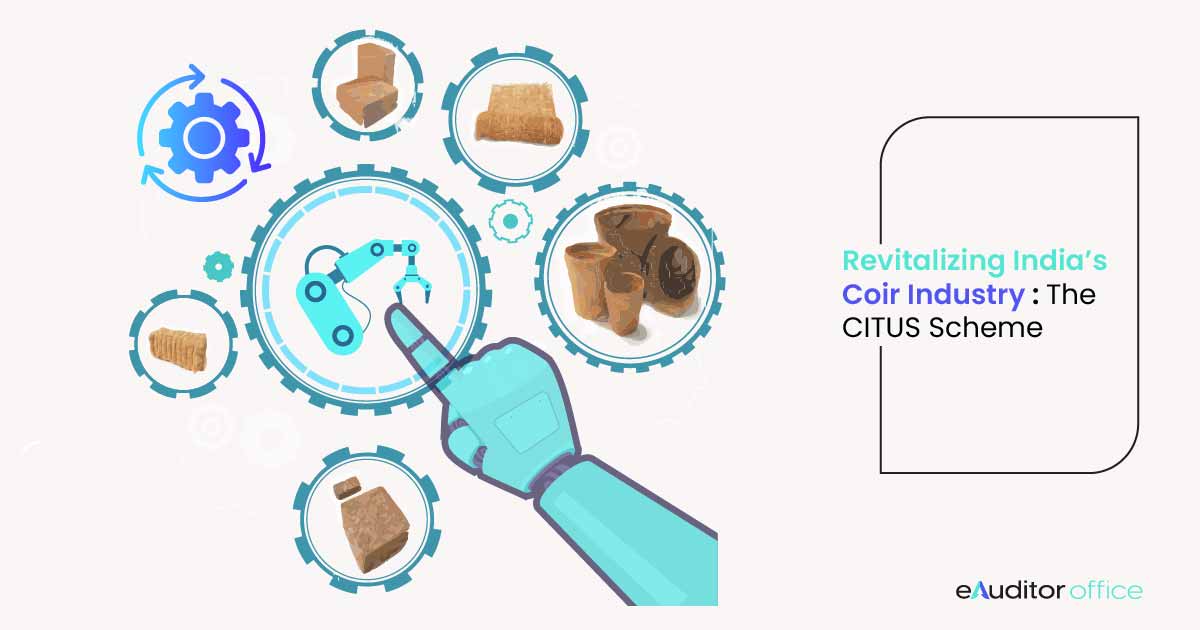
What is the Coir Industry Technology Upgradation Scheme?
The Ministry of Micro, Small, and Medium Enterprises has launched the Coir Industry Technology Upgradation Scheme (CITUS) to provide financial assistance to coir units for the modernization and up-gradation of their technology and infrastructure.
The scheme aims to improve the quality of coir products and increase productivity, thereby enhancing the competitiveness of the coir industry in domestic and international markets.
Under CITUS, coir units can avail of a subsidy of up to 25% of the cost of plant and machinery for upgradation and modernization. The scheme also assists in the installation of new machinery, the creation of common facility centers, and the adoption of new technology.
Read More: Coir Udyami Yojana
Objective of Coir Industry Technology Upgradation Scheme:
- Provide modern infrastructure to production units to improve productivity and quality.
- Support the establishment of new, high-tech coir processing units.
- Expand the industry to new areas.
- Utilize available raw materials more effectively.
- Create more job opportunities, especially for women in rural areas.
- Encourage new entrepreneurs to join the industry.
- Modernize existing coir units.
- Promote the use of technology, including enterprise resource planning.
- Produce high-value, customer-oriented products.
- Make the coir industry more competitive and integrated with modern technologies.
- Adopt eco-friendly production techniques.
- Achieve a pollution-free coir industry through technological advancements.
Challenges Faced By The Coir Industry:
The coir industry is a labor-intensive and export-oriented industry, employing more than seven lakh workers, predominantly women. The decentralized operations in the coir industry without adequate training of spinners, weavers, and artisans engaged in value-added product manufacturing have posed problems, particularly in ensuring the desired quality in the ultimate products. Some of the key issues are mentioned below:
- Substandard quality and workers’ involvement in production activities without sufficient training prove detrimental to the industry’s survival.
- Coir is a traditional product; space for skill development is crucial for the industry’s overall development.
- Training and upskilling become imperative for increasing the coir industry into untested, non-traditional areas.
The Coir Board has been organizing quality improvement camps and entrepreneurship development programs to achieve these objectives.
Financial Assistance Under Coir Industry Technology Upgradation Scheme (CITUS):
- Individuals
- Partnership firms
- SHGs (Self-Help Groups)
- Associations
- Small, medium, cooperative, private, and public sector enterprises are interested in producing value-added coir or coir-blended items, where coir is the dominant fiber.
- Assistance is given for setting up new units or increasing the capacity of existing units, with investment only in new machinery.
- No assistance will be given to units that exceed investment limits for medium-scale enterprises as per the MSME Act.
- Eligible units can get financial assistance purchasing new machinery for modernization, upgrading, or setting up a new unit.
- The financial assistance is 25% of the cost of the machinery and has an upper limit of Rs. 2.50 crores per unit/project.
- The financial assistance will be transferred directly through DBT mode and PFMS to reimburse the amount invested.
- The assistance will be released after the unit installs the eligible machinery and starts its operation.
- The applicant units can buy the plant and machinery with a loan from any financial institution, bank, leasing company, or their resources.
Eligibility Criteria For Coir Industry Technology Upgradation Scheme (CITUS):
- Coir production/processing units that are newly established or registered with the Coir Board and have Udyog Aadhar can apply for financial assistance for modernization under the CITUS scheme.
- A new unit that has already applied for/availed of assistance under the scheme must have completed five years of successful operation before applying for modernization assistance.
- Financial assistance is available to the entire coir sector of the country, and the units applying for assistance must be within the investment limits prescribed for Small and Medium Enterprises under the MSME Act.
- The application and relevant documents must be filed online. A Regional Officer/ Sub Regional Officer/ In-charge of the Coir Board will inspect the unit and recommend it for sanction by the Competent Authority.
- The machinery and motors eligible for assistance must meet the standards prescribed by BIS.
- The overall ceiling for financial assistance is Rs. 2.5 crores.
- A four-member Technical Committee will fix and review the prices of different machinery items periodically, and the list will be updated as necessary.
- The machinery/equipment must be sourced from the open market or imported per BIS standards, with valid receipts/invoices and GST numbers.
- Machinery suppliers must provide the beneficiaries with a performance guarantee for at least two years.
- The cost of new machinery/equipment installed/procured will be used to calculate the financial assistance for modernization projects.
- The financial assistance is not available to entrepreneurs who have already availed of Central Government subsidies under PMEGP, CUY, DPI, TUF, etc.
- In the case of original documents pledged with banks, the copies must be submitted with the application and attested by the bank’s Manager.
- The cases of applications will be placed before a “Project Steering Committee” at the Coir Board Head Quarters, which will meet at least once every two months.
Types Of Coir Units Covered Under This Scheme:
Under the Coir Industry Technology Upgradation Scheme (CITUS), financial assistance is provided to various coir units to modernize and upgrade their technology and infrastructure. The scheme covers the following categories of coir units:
Primary Coir Processing Units These units are engaged in the production of raw coir fiber and yarn.
Spinning and Weaving UnitsThese units produce coir products like coir mats, carpets, rugs, and geotextiles.
Coir Pith Processing Units – These units process coir pith, a by-product of the coir fiber extraction process, into various value-added products like coir pith blocks, briquettes, and pellets.
Coir Plywood Manufacturing Units – These units manufacture coir plywood, a composite material made from coir fiber and resin layers.
Coir Products Manufacturing Units – These units produce various coir products like coir mattresses, cushions, and upholstery.
Conclusion:
The Coir Industry Technology Upgradation Scheme (CITUS) has significantly impacted the coir industry and the Indian economy since its launch. By providing financial assistance for the modernization and up-gradation of technology and infrastructure, the scheme has improved the quality of coir products, increased productivity, and enhanced the competitiveness of the coir industry in both domestic and international markets.
Adopting eco-friendly and energy-efficient technologies has not only reduced the environmental impact of coir production. Still, it has also led to an increase in employment opportunities, especially in rural areas.
Additionally, the modernization of coir units has played a vital role in developing small and medium-sized coir units, which contribute significantly to India’s MSME sector. This scheme has increased exports, generated foreign exchange earnings for the country, and contributed to the overall growth of the Indian economy.
For more details about government schemes, startup registration and business compliances related queries, check out our eAuditor Office website or you can directly talk to our experts now.
The CITUS supports the marketing of coir products by providing financial assistance to coir units for participating in domestic and international exhibitions and fairs. The scheme also includes assistance in developing marketing materials like brochures, catalogs, and websites. These assistance helps coir units enhance their brand image, expand their market reach, and increase sales and revenue.