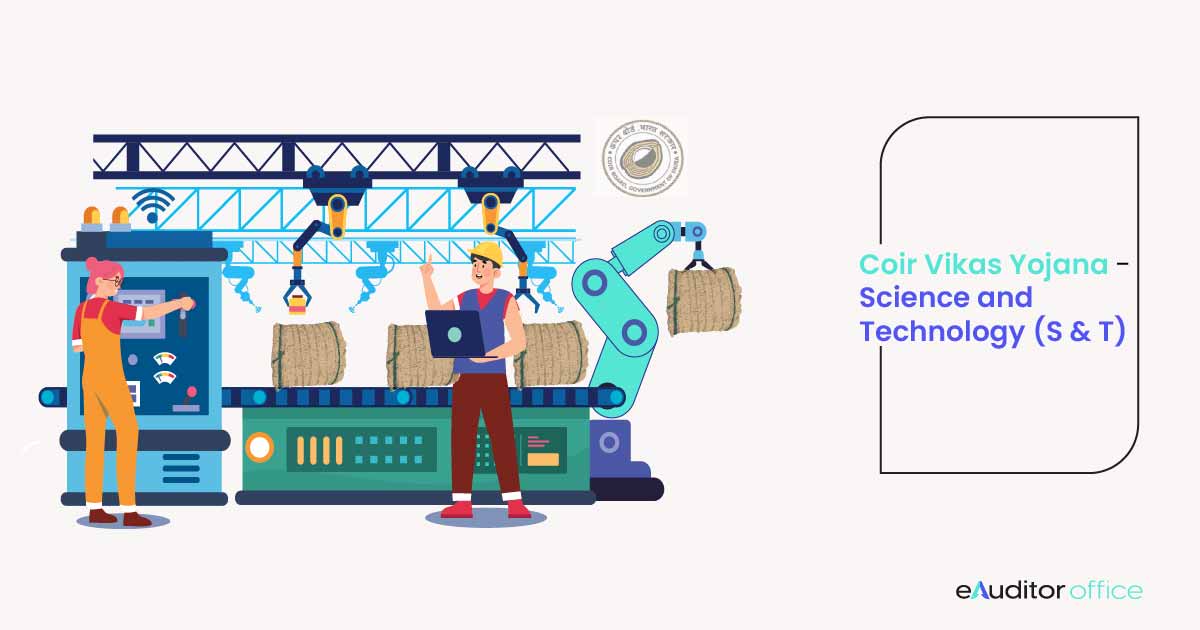
What Is Coir Vikas Yojana (CVY)?
Coir Vikas Yojana is a scheme launched by the Government of India to promote the development and growth of the coir industry. Out of many components, the Science and Technology (S&T) component of the Coir Vikas Yojana is focused on modernizing and mechanizing traditional coir production methods to increase productivity and improve the quality of coir products. The scheme aims to promote the use of eco-friendly technologies for coir production and develop new machinery for the coir industry.
The scheme also includes training and capacity-building programs for coir workers and entrepreneurs to help them improve their skills and business practices. The goal is to make the coir industry more sustainable and competitive in the global market through advanced technologies and modern production methods.
In addition, the scheme also aims at promoting coir-based innovative products, such as coir geotextiles, coir pith based bio-fertilizer, coir-pith-based substrates for horticulture, coir pith-based mushroom cultivation, and other value-added products. This will help in generating additional income for the coir farmers and workers.
Read More: Coir Industry Technology Upgradation Scheme (CITUS): Reviving India’s Coir Industry
Significance Of Science & Technology In The Coir Industry:
Science and technology play a significant role in the coir industry by promoting modern and sustainable production practices, enhancing the quality of coir products, and increasing the industry’s competitiveness in domestic and international markets.
Using advanced machinery and equipment, coir units can increase their productivity and efficiency, leading to higher revenue and employment opportunities. Additionally, adopting eco-friendly and energy-efficient technologies can reduce production costs and promote sustainable production practices, making the industry more environmentally responsible.
Overall, integrating science and technology in the coir industry can help transform the sector, making it more competitive, sustainable, and economically viable.
How is CVY promoting S&T in the Coir Industry?
The Coir Vikas Yojana (CVY) promotes science and technology in the coir industry by providing financial assistance to coir units to modernize and upgradation of technology and infrastructure.
Under the scheme, coir units can avail of financial assistance for adopting eco-friendly and energy-efficient technologies, developing new products, and developing R&D activities. This support can lead to increased productivity, higher quality of coir products, and reduced production costs, making the coir industry more competitive in domestic and international markets.
Moreover, the scheme encourages establishing Common Facility Centres (CFCs) and testing facilities to promote research and development in the coir industry. By facilitating the adoption of modern technology and promoting research and development, the CVY plays a vital role in the sustainable development of the coir industry in India.
The government of India has established two research institutes, the Central Coir Research Institute (CCRI) in Kalavoor and the Central Institute of Coir Technology (CICT) in Bangalore, to carry out innovative R&D activities on coir.
The CCRI, established in 1959, focuses on developing eco-friendly technologies to improve the quality of coir fiber, utilizing coir pith, effluent treatment, and developing new machinery.
Meanwhile, the CICT, established in 1980, primarily focuses on technology development for coir composites. Both institutes aim to identify new ways to utilize coir and coir waste, modernize production infrastructure, and improve the quality and productivity of the coir industry.
The research conducted by these institutes is also scaled up for field-level application, and testing and service facilities are extended to coir entrepreneurs and exporters.
The scheme also aims to increase productivity, improve the quality of coir products, and promote the use of eco-friendly technologies in the industry. Overall, the government of India is committed to supporting the growth and development of the coir industry through the Coir Vikas Yojana and the research efforts of the CCRI and the CICT.
Overview of the CVY’s programs and initiatives aimed at promoting S&T in the coir industry
The Coir Vikas Yojana (CVY) has several programs and initiatives aimed at promoting science and technology (S&T) in the coir industry, including:
- Modernizing production processes
- Developing machinery and equipment
- Product development and diversification
- Developing environment-friendly technologies, and
- Providing technology transfer, incubation, testing, and service facilities.
Modernization of Production Processes:
The objective of the modernization of the production processes component of the Coir Vikas Yojana is to improve the efficiency, productivity, and quality of the coir industry. It includes several specific objectives, such as:
- Modernization of the coir fiber extraction process enhances productivity and eliminates drudgery.
- Developing appropriate technologies for improving productivity and quality in spinning.
- Developing innovative technologies in weaving coir products by improvising fiber and equipment production processes.
- Developing modern technologies for finishing operations of coir products.
- Modernization of the production and extraction process through the application of biotechnology.
- Development of technologies for wet processing of coir using natural dyes.
- Extraction of good quality fiber using a Mobile Fiber Extraction Machine, which will be modified to produce fiber of uniform length and reduce impurities.
- Developing technologies for quality improvement of coir fiber using bio-chem and enzyme treatment.
- Development of diversified products using superior quality fiber, such as Janata Mattress and superior quality coir floor coverings.
The conventional technologies used in the coir industry are generally of medium level, which results in a high amount of drudgery and an unfriendly working atmosphere for retaining a dedicated workforce.
Through continued research and development activities, both the internal and external markets are expected to accept new technologies for processing coir and developing new coir products.
Development of Machinery and Equipment:
The Development of Machinery and Equipment component of the Coir Vikas Yojana aims to improve the efficiency and productivity of the coir industry by developing new machinery. The objectives of this component are to
- Elimination of drudgery in operations
- Improvement in productivity and quality
- Bringing about cost-effectiveness
The existing machinery in the industry needs to be updated with low productivity and involves a lot of manual labour. The coir industry faces challenges such as low productivity, lack of technology application, reluctance to adopt mechanization, and lack of funds for modernization.
To overcome these challenges, this component aims to develop new machinery to process coir fiber into yarn and products with increased productivity.
Product Development and Diversification:
The Product Development and Diversification component of the Coir Vikas Yojana aims to create new and innovative products from coir fiber or blend it with other natural fibers. This component also aims to find new areas of application for coir products, such as coir geotextiles and new technologies for utilizing coir pith.
Additionally, it will focus on developing technologies for using coir in the automobile industry for seat cushions and upholstery and creating unique designs for mats, matting, and carpets.
The component plans to use coir geotextiles to construct rural roads under PMGSY and establish Design Clinics in major coir clusters and CCIR/CICT.
The future of the coir industry depends on developing new products and finding new areas to use coir. It includes creating substitutes for wood and synthetic products, blending coir with other natural fibers, and developing new applications for coir. Developing innovative eco-friendly products that consumers will accept is crucial for the industry to reach its full potential. Coir wood, in particular, has the potential to bring significant changes to the building and furnishing sector and could also help preserve tropical forests and reduce the impact on the world’s climate.
Development of Environment-Friendly Technologies:
The eco-friendly technology development in Coir Vikas Yojana aims to promote sustainable coir production while protecting natural resources, reducing greenhouse gas emissions, and enhancing global competitiveness.
- Develop technologies to reduce pollution in coir production processes
- Create an eco-friendly, cost-effective method for treating wet-processing effluents in the coir industry
- Develop ways to dispose of sludge in the effluent treatment plants
- Research new wood substitutes made from coir or blend them with other natural fibers
- Standardize coir composite products for different uses
- Study the potential for earning carbon credits through using coir products such as composites and geotextiles
- Research new technology for making coir toys.
As the world is getting more aware of the importance of protecting natural resources, it is increasingly important to minimize environmental hazards in all industries, including the coir industry. Although coir and its products are biodegradable, research must be done to reduce the negative impact of wet processing processes on the environment.
Technology Transfer, Incubation, Testing, and Service Facilities
The objective of Technology Transfer, Incubation, Testing and Service Facilities in Coir Vikas Yojana is to promote innovation, support startups and entrepreneurs, improve the quality of coir products, and enhance the competitiveness of the coir industry through research and development.
- Transfer new technologies developed by research institutes to industry partners for a fee.
- Create technology incubation centers for training entrepreneurs in new technologies.
- Build a tool room for maintaining and repairing equipment in coir production centers.
- Establish a laboratory for testing coir composite materials and provide services to the industry.
- Demonstrate new technologies and machinery for workers and entrepreneurs in major coir production centers.
- Provide technical assistance for improvement in coir-producing clusters identified by the Board.
- Test coir and coir products, dyed samples, and coir pith at research institutes and issue certificates.
- Offer dyeing services for coir yarn and fiber at the CCRI dye house.
- Provide infrastructure support for research institutes such as CCRI/CICT.
Conclusion:
The overall goal of the Coir Vikas Yojana is to increase the productivity, efficiency, and competitiveness of the coir industry while also minimizing its environmental impact.
The scheme also focuses on developing new and innovative products, finding new application areas for coir, and reducing drudgery in operations through modernization.
The scheme is intended to help the coir industry to grow and be competitive in the global market.
For more details about other government schemes, startup registration and business compliances related queries, check out eAuditor Office
Science and Technology can increase the productivity and quality of coir products by facilitating mechanization through modern machinery and equipment, research and development, quality control, value addition, and training and capacity-building programs for coir workers and entrepreneurs. Science and Technology can increase the productivity and quality of coir products by facilitating mechanization through modern machinery and equipment, research and development, quality control, value addition, and training and capacity-building programs for coir workers and entrepreneurs.