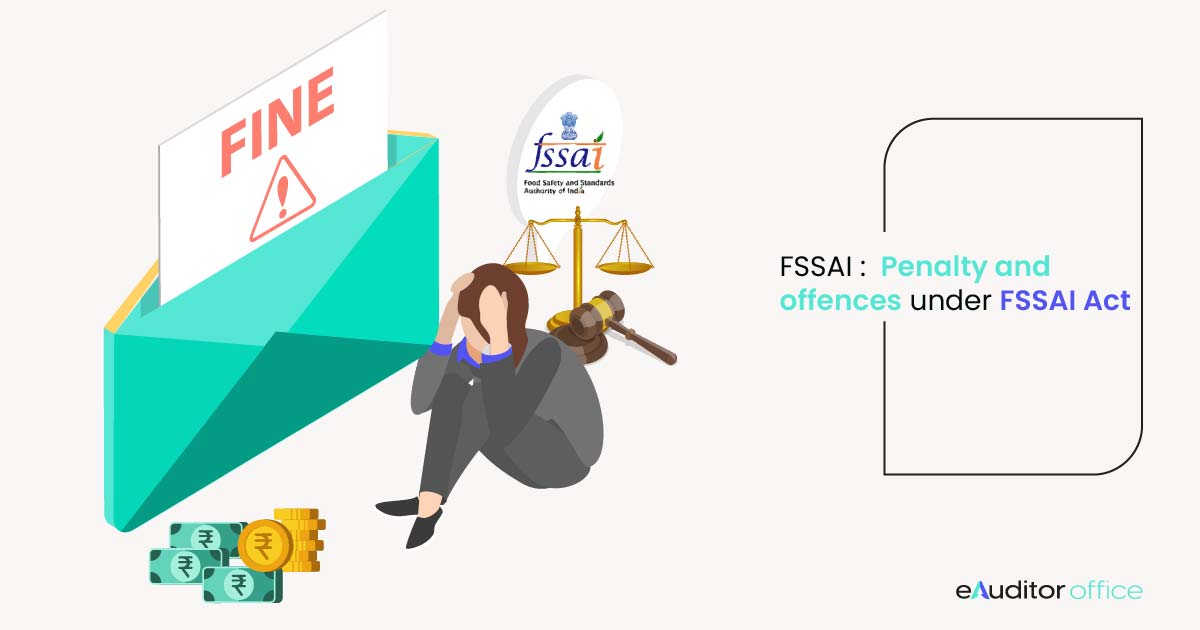
The Food Safety and Standards Act, 2006 was passed by the Indian Government to ensure food safety within the country and establish food safety standards relating to the same. Further, it necessitated the people operating the food business in India to obtain an FSSAI licence. This ensured that only the registered persons who have been verified by the appropriate authorities manufacture, store, distribute or sell the food products within India.
To ensure compliance with the FSSAI guidelines and provisions, the government incorporated various penal provisions to penalise the non-compliant people. The act lays down explicit provisions relating to the offences under the FSSAI act and the food safety penalties for the same like punishment for food adulteration in India, selling substandard food etc. Let’s understand the penal provisions and how you can avoid the same under FSSAI Act.
Offences and Penalties Under FSSAI
The following are some of the offences and food safety penalties that are charged under the FSSAI law:
|
Sections |
Offences |
Penalties |
|
Section 50: Penalty for selling food that is not of the nature, quality or substance demanded. |
Selling food that does not comply with the provisions of the FSSAI Act or any regulations made thereunder or if the food is not of the nature, quality or substance demanded by the buyer |
A penalty not exceeding Rs. 5 lakhs shall be payable. |
|
Section 51: Penalty for sub-standard food |
A person who either himself or any other person on his behalf manufactures, stores, sells, distributes or imports food for human consumption that is of sub-standard quality. |
A penalty that may extend up to Rs. 5 lakhs shall be payable. |
|
Section 52: FSSAI penalty for misbranding of food |
A person who either himself or any other person on his behalf manufactures, stores, sells, distributes or imports food for human consumption that is misbranded. |
A penalty that may extend up to Rs. 3 lakhs shall be payable. |
|
Section 53: Penalty for misleading advertisement |
A person who publishes or is a party to the publication of an advertisement that either falsely describes any food or misleads in relation to the quality or substance of any food or gives a false guarantee. |
A penalty that may extend up to Rs. 10 lakhs shall be payable. |
|
Section 54: Penalty for food containing extraneous matter |
A person who either himself or any other person on his behalf manufactures, stores, sells, distributes or imports food for human consumption that contains extraneous matter. |
A penalty that may extend up to Rs. 1 lakh shall be payable. |
|
Section 55: Penalty for failure to comply with the directions of FSO |
A food business operator or an importer fails to comply with any of the requirements of the FSSAI act or any rules or regulations made thereunder or orders issued by the Food Safety Officer. |
A penalty that may extend up to Rs. 1 lakh shall be payable. |
|
Section 56: Penalty for unsanitary or unhygienic processing or manufacturing of food |
A person who either himself or any other person on his behalf manufactures, or processes food for human consumption under unhygienic or unsanitary conditions. |
A penalty that may extend up to Rs. 1 lakh shall be payable. |
|
Section 57: Penalty for possessing adulterant |
A person who either himself or any other person on his behalf manufactures, stores, sells, distributes or imports any adulterant. |
If the adulterant is not injurious to health, a penalty not exceeding Rs. 2 lakhs shall be payable. If the adulterant is injurious to health, a penalty not exceeding Rs. 10 lakhs shall be paid. |
|
Section 58: Penalty for contravention of FSSAI rules |
Contravention of any of the provisions of the FSSAI Act, rules or regulations made thereunder for which no separate penalty has been provided. |
A penalty that may extend up to Rs. 2 lakhs shall be payable. |
|
Section 59: Punishment for unsafe food |
A person who either himself or any other person on his behalf manufactures, stores, sells, distributes or imports food for human consumption that is unsafe. |
The following shall be the penalties in such case:
|
|
Section 60: Punishment for interfering with seized items |
A person retains, removes, or tampers with any food, equipment, vehicle, package or labelling or advertising material or any other thing seized under this act without the permission of the Food Safety Officer. |
Imprisonment that may extend up to 6 months and fine that may extend up to Rs. 2 lakhs. |
|
Section 61: Punishment for false information |
A person who provides any false information or document that such person knows is misleading. |
Imprisonment that may extend up to 3 months and fine that may extend up to Rs. 2 lakhs. |
|
Section 62: Punishment for obstructing or impersonating an FSO |
A person resists, excuses, obstructs or attempts to obstruct, threaten, intimidate, impersonate or assault a Food Safety Officer in the exercise of his functions under the FSSAI act. |
Imprisonment that may extend up to 3 months and fine that may extend up to Rs. 1 lakh. |
|
Section 63: Punishment for carrying out a business without an FSSAI licence |
A person or a food business operator (either himself or through any other person) manufactures, stores, distributes, sells or imports any food without FSSAI certification licence. |
Imprisonment that may extend up to 6 months and fine that may extend up to Rs. 5 lakhs. |
|
Section 64: Punishment for subsequent offences |
If a person again commits and is convicted of an offence that he was previously convicted for. |
Twice the punishment that was imposed in the first conviction subject to the maximum punishment provided for that offence. If the offence is a continuing one, a daily fine that may extend up to Rs. 1 lakh shall be payable. Further, the licence shall be cancelled. |
|
Section 65: Compensation in case of injury or death of the consumer |
A person who either himself or any other person on his behalf manufactures, stores, sells, distributes or imports food causing injury to the consumer or his death. |
A compensation to the victim or his legal representative shall be paid that shall be-
|
Impact of FSSAI Penalties on Food Business
FSSAI Act has imposed stringent penalties in case any of the above offences are committed by any person. As food directly impacts the health of a person, it is important for food business operators to stay cautious while providing food items to consumers. Customers can file FSSAI complaints if they don’t receive the quality food. Stringent penalties in force ensure that the food business operators exercise due caution and prevent any negligence that can impact the health of their customers.
How to Avoid FSSAI Offences and the Consequences of Non-Compliance?
Avoiding FSSAI offences and the consequences of non-compliance isn’t a difficult task. One may simply avoid any legal action under the FSSAI act by adhering to the relevant requirements, obtaining the relevant FSSAI registration and approvals and delivering quality food products to their customers. Exercising due caution, maintaining hygiene and delivering quality food products is the best way to not only avoid legal consequences of the FSSAI act but also win the trust of the customers.
Future of Food Safety: The Benefits of Maintaining FSSAI Compliance
Compliance with FSSAI regulations is mandatory for all food businesses in India, including food manufacturers, distributors, and retailers. There are many benefits to maintaining FSSAI compliance in India, including:
- Ensuring Food Safety: FSSAI guidelines and regulations are designed to ensure the safety of food products for consumers. Compliance with these regulations can help prevent foodborne illnesses and other health hazards.
- Improving Brand Reputation: By complying with FSSAI regulations, food businesses can demonstrate their commitment to food safety and quality. This can help improve their brand reputation and increase customer loyalty.
- Meeting Legal Requirements: Compliance with FSSAI regulations is mandatory for all food businesses in India. Failing to comply can result in fines, legal action, and even the closure of the business.
- Accessing New Markets: Many retailers and distributors require FSSAI compliance as a condition of doing business. By maintaining compliance, food businesses can access new markets and expand their customer base.
- Increased Consumer Confidence: Compliance with FSSAI regulations can help build consumer confidence in a brand. Consumers are more likely to trust and purchase products from a brand that they know is following strict food safety and quality standards.
- Avoiding Product Recalls: Non-compliance with FSSAI guidelines and regulations can lead to product recalls, which can be costly and damaging to a brand’s reputation. By maintaining compliance, food businesses can avoid these costly and damaging incidents.
Why Food Business Owners Should Take FSSAI Regulations Seriously
Above were the detailed provisions governing the offences and FSSAI fine payments. FSSAI law is a perfect example of a popular saying i.e., ‘If you think compliance is expensive, try non-compliance’. Thus, if you are operating in the food industry, it is paramount that you check the applicability of FSSAI provisions and regulations and ensure that you adhere to all the required compliances. In case you need any assistance in relation to FSSAI compliance, feel free to contact the eAuditor Office