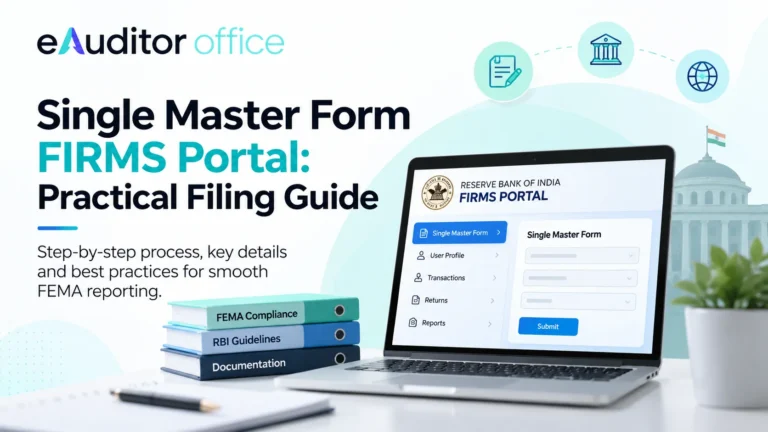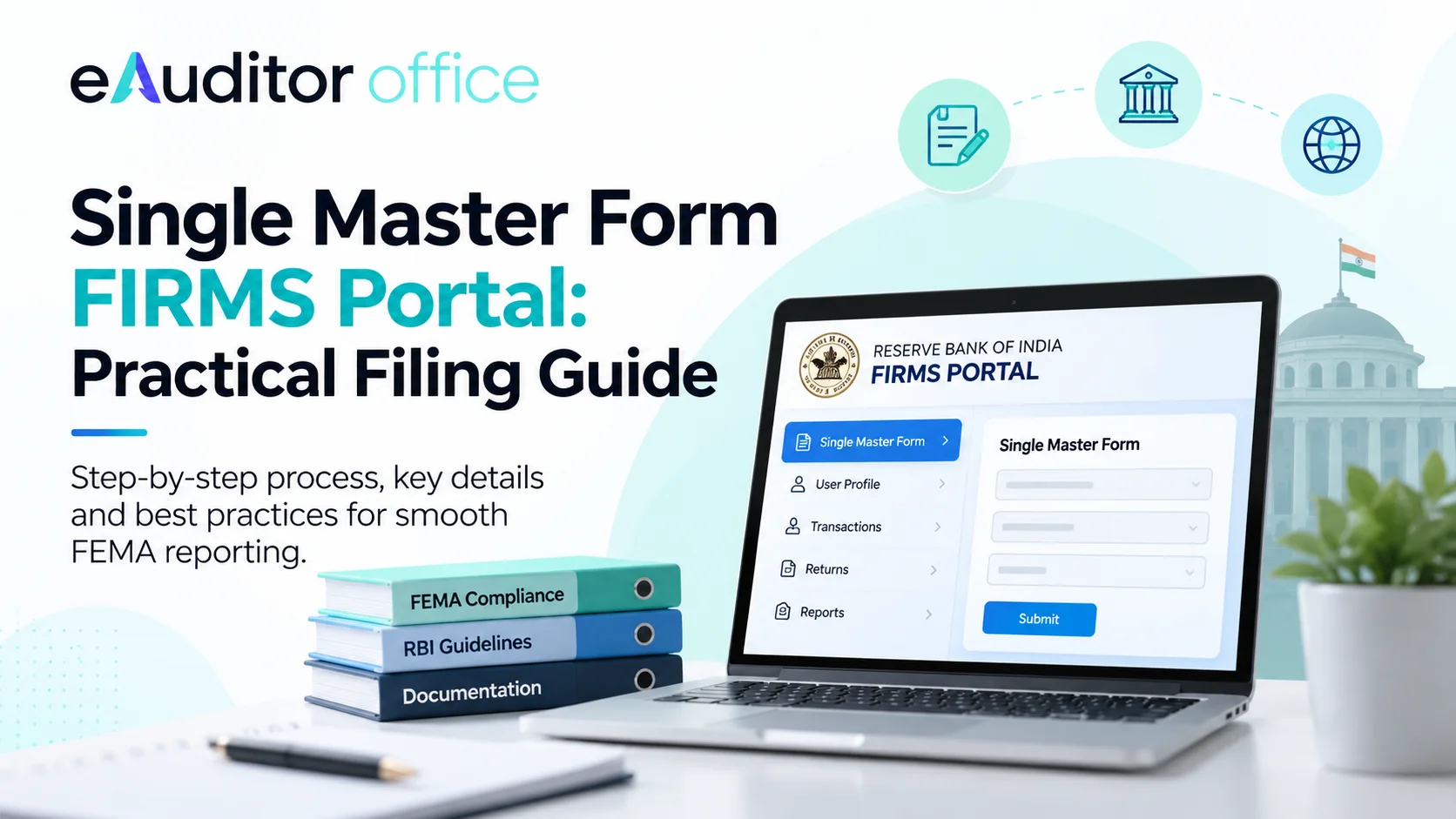
The Single Master Form FIRMS portal is the Reserve Bank of India’s online system for reporting several types of foreign investment in India. An Indian company, LLP, investment vehicle or other responsible filer uses the relevant SMF return for a transaction such as issuing shares to a non-resident, transferring equity instruments or reporting downstream investment.
SMF is not one identical form for every transaction. It is a common framework containing different returns, deadlines and reporting responsibilities.
Setting Up An Indian Company With Foreign Ownership? E-Auditor’s Foreign Subsidiary Incorporation support can help connect incorporation, banking, share issuance and the first FEMA reporting cycle so that the portal filing is not left until the deadline.
What Are SMF And The FIRMS Portal?
SMF stands for Single Master Form. FIRMS stands for Foreign Investment Reporting and Management System. RBI introduced it to integrate foreign-investment reporting. The system includes Entity Master information and transaction-based returns.
The portal is used for reporting. It does not replace the need to comply with the Foreign Exchange Management Act, the Non-Debt Instruments Rules, sectoral caps, entry routes, pricing rules or government-approval conditions.
Which Forms Are Available Under SMF?
The return must match the underlying transaction:
| SMF Return | Typical Reporting Event | General Deadline |
| FC-GPR | Issue of equity instruments by an Indian company to a person resident outside India | Within 30 days from the date of issue |
| FC-TRS | Reportable transfer of equity instruments between resident and non-resident parties | Within 60 days of transfer or receipt/remittance of funds, whichever is earlier |
| LLP(I) | Receipt of consideration by an LLP for capital contribution or profit share | Within 30 days from receipt |
| LLP(II) | Transfer or disinvestment of LLP capital contribution or profit share between resident and non-resident | Within 60 days from receipt of funds |
| ESOP | Issue of employee stock options to eligible persons resident outside India | Within 30 days from issue |
| DRR | Issue or transfer of depository receipts | Within 30 days from closure of the issue |
| DI | Downstream investment treated as indirect foreign investment | Within 30 days from allotment of equity instruments |
| CN | Issue or transfer of convertible notes involving a person resident outside India | Within 30 days from issue or transfer |
| InVI | Issue of units by an investment vehicle to a person resident outside India | Within 30 days from issue |
RBI’s reporting directions prescribe these return types and timelines. The correct trigger date matters because the deadline does not always run from the date money first reaches the bank. genui{“citation”:{“refs”:[“turn35search0″,”turn35search4”]}}
Before Filing: Complete The Portal Setup
1. Check The Entity Master
Check the company name, CIN or LLPIN, registered office, authorised dealer bank, shareholding and existing foreign investment in the Entity Master.
A mismatch between master data and the transaction can block filing or trigger AD-bank queries.
2. Register The Appropriate User
The filer needs Business User access and proper authorisation from the entity, including the prescribed authority letter during registration.
Check the email, mobile number, PAN, entity identification and AD-bank details. Avoid using a former employee’s login.
3. Confirm The Designated AD Bank
Select the AD bank handling the remittance and confirm the branch and IFSC with its FEMA team.
Documents To Prepare Before Opening The Return
The attachment set varies by return, but companies commonly need:
- Board resolution approving the issue, transfer or investment
- Inward remittance evidence and FIRC or bank advice, where applicable
- KYC report for the foreign investor
- Valuation certificate and pricing-support documents
- Government or sectoral approval, if the transaction is not fully under the automatic route
- Compliance declarations on sectoral caps, entry route and pricing
Names, dates, consideration and instruments should agree across the agreement, bank evidence, valuation and statutory filings.
Step-By-Step SMF Filing Process
Step 1: Identify The Reporting Event
Identify whether the event is an issue, transfer, downstream investment, LLP contribution, convertible note, ESOP or investment-vehicle unit issue.
Confirm who must report. FC-GPR is filed by the issuing Indian company, while FC-TRS responsibility depends on the transfer.
Step 2: Calculate The Deadline
Record the legal trigger date. FC-GPR uses the issue date; FC-TRS considers both the transfer date and receipt or remittance of funds.
Do not substitute the board, agreement or bank-credit date unless it is the prescribed trigger.
Step 3: Log In And Select The Return
Log in with the Business User account, open SMF, choose the entity and select the return.
Confirm the entity and AD bank before entering data.
Step 4: Enter The Transaction Details
Enter the investor, country, remittance, instrument, date, consideration, valuation, sector and foreign shareholding.
Use executed documents as the source and reconcile figures with bank and corporate records.
Step 5: Upload The Supporting Documents
Upload legible, signed and current documents in the accepted format and size. Use clear filenames.
Do not use unrelated placeholders for non-applicable documents. Explain the position where permitted.
Step 6: Review And Submit
Check names, dates, currency, instruments, face value, premium, consideration, ownership and valuation.
Save the acknowledgement, timestamp and reference number. RBI auto-acknowledged forms submitted with the required documents. genui{“citation”:{“ref”:”turn36view0″}}
Step 7: Track The AD Bank Review
Auto-acknowledgement is not final verification. The AD bank checks the documents and should verify submitted forms within five working days. genui{“citation”:{“ref”:”turn36view0″}}
Monitor the portal and email for approval, rejection or remarks. Respond with corrected, consistent records.
What Happens If The Filing Is Late?
The portal identifies delayed reporting. Under RBI’s 2023 framework, a form delayed by up to three years may be processed subject to payment of the system-calculated Late Submission Fee. For a delay exceeding three years, approval is subject to compounding of the contravention. genui{“citation”:{“ref”:”turn36view0″}}
Paying an LSF does not cure every FEMA issue. The transaction must still satisfy entry-route, sectoral-cap, pricing and approval conditions.
Common FIRMS Portal Mistakes
Frequent problems include choosing the wrong return or trigger date, outdated Entity Master data, incorrect AD-bank mapping, incomplete KYC, unsigned attachments and figures that conflict with the valuation. Reconcile corporate, banking and FEMA records before submission.
Build FIRMS Reporting Into The Incorporation Plan
A single master form FIRMS portal filing is easier when the incorporation documents, bank records, valuation and share-allotment data are prepared as one compliance file. Waiting until the last week creates unnecessary risk.
For help with company setup, capital structuring and post-incorporation FEMA reporting, speak with an E-Auditor about Foreign Subsidiary Incorporation before receiving or allotting foreign investment.
FAQs
No. Entity Master contains the entity’s foundational foreign-investment information. SMF contains transaction-specific returns such as FC-GPR, FC-TRS and Form DI.
No. It confirms submission with a timestamp. The AD bank still verifies the documents and regulatory compliance.
No. FC-GPR reports an issue of equity instruments by an Indian company. FC-TRS reports specified transfers involving resident and non-resident parties.
The return is routed to the selected AD Category-I bank, which checks the filing against the documents and applicable foreign-investment rules.
Begin portal setup and bank coordination early. Reporting becomes due when the relevant event occurs, such as issuing equity instruments.